Showing posts with label Barbarian Messiah. Show all posts

Monday, 30 March 2015

Eric Hoffman's "Cerebus The Barbarian Messiah"

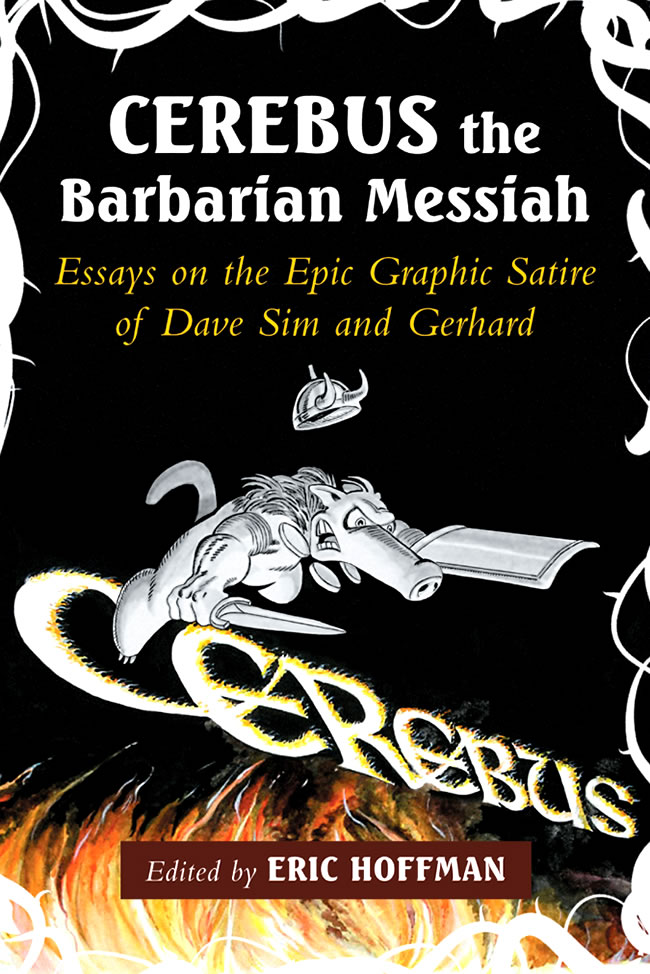
Cerebus the Barbarian Messiah (2012)
Edited by Eric Hoffman 

MOTION PICTURES COMICS.com:
(from the Motion Pictures Comics blog, 14 April 2014)
Cerebus the Barbarian Messiah: Essays on the Epic Graphic Satire of Dave Sim and Gerhard is exactly what the book’s title promises.  It's a collection of essays by different authors, attempting to take a serious, scholarly look at various aspects of Cerebus, Dave Sim & Gerhard’s 300-issue independent comic book masterpiece. I found myself occasionally rolling my eyes at some of the overly verbose scholar-speak in the essays, but mostly I was delighted by this serious look at an important (albeit controversial) comic book work, and I found it a thrill to dive back into the deep, crazy waters of Cerebus.

For the uninitiated, Cerebus is a 300-issue-long black-and-white self-published comic book. At first the series was written and drawn by Dave Sim by himself, but eventually he was joined by Gerhard as his partner on the art.  What began as a silly parody of Marvel Comics' Conan series (illustrated at the time by Barry Windsor-Smith) evolved into an incredibly complex saga that dealt with politics and religion and male-female relationships.  If one were to sit down to read 300 consecutive issues of, say, Spider-Man or Batman or Superman, it would become quickly obvious that the stories, while having some continuity, couldn’t possibly represent events that could actually happen to a real character.  There might be the illusion of change, but ultimately all of these characters have to remain in a perpetual status quo.  Sim set out to do something completely different, to tell the story of the life a character -- the titular Cerebus -- in 300 issues, with the 300th issue chronicling the character's death.  Over the course of twenty-six years, Sim and Gerhard did exactly that.

That alone would make Cerebus a jaw-dropping achievement. I am hard-pressed to think of any example of long-form story-telling that can come close to matching this sisyphian effort of telling the story of Cerebus in monthly twenty-page installments over twenty-six years.  But there’s far more to Cerebus than just Sim and Gerhard’s endurance. The story is at points hilarious and thrilling and infuriating.  It can shift from juvenile humor (when Cerebus is funny, it is VERY VERY funny) to incredible action-adventure to painfully sharp observations of marital discord. The series features a wealth of fascinating characters and settings.  Cerebus is one of the most complex, fascinating examples of fantasy world-building ever made, rivaling J.R.R. Tolkien's Lord of the Rings, Isaac Asimon's Foundation, and George R. R. Martin's Game of Thrones.

The series also pushed the boundaries of comic book art farther than any other series I can think of. Sim and Gerhard experimented gloriously with page-layout, with different approaches to the combination of words and pictures and the use of large blocks of prose (sometimes without any accompanying illustrations at all).  Mr. Sim's sharp ear for dialect and accent resulted in extraordinarily wonderful, distinct dialogue for his different characters.  And I stand firm in my assessment that the lettering in Cerebus -- particularly in the final hundred-or-so issues -- is the finest achievement in comic book lettering ever created.  Mr. Sim's extraordinarily expressive word-balloons and lettering brought his characters' subtlest inflections and inner thoughts to gorgeously realized life.

Cerebus is also a profoundly frustrating, confounding piece of work in that, in the series’ final third, the tone and focus of the story shifted dramatically into areas many readers found unsettling and/or disappointing.  I have read the experience of reading Cerebus in its entirety described as an opportunity to watch its creator Dave Sim go slowly insane, and I think there is much evidence in support of that theory.  In the three decades of producing the comic, Dave Sim came to possess some extraordinarily unusual opinions about women and religion that earned him the label of misogynist in the pages of The Comics Journal and that lost him a great many readers. (I am not sure that misygonist label is fair, but there's no question that I find many of the opinions Sim came to possess about women to be deeply distasteful.)  I tend to be able to separate an artist's personal life and beliefs from his/her work, but there's no question that Sim's weird ideas crept into the Cerebus narrative in a way that unfavorably, for me, color its concluding volumes. The infamous text-only issue #186 consists almost entirely of an anti-woman rant that is difficult to stomach, and the six issues spent late in the series in a bizarre, loony analysis of the first several chapters of the Torah (a sequence nicknamed "Cerebexegesis" by readers) is -- while funny at times and fascinating at others -- such a far cry from what fans like me used to know and love about the series as to be difficult to fathom.  (Dave Sim has stated that those six issues represent his actual thinking about the Torah, which makes the experience of reading them like staring deeply into the mind of a very crazy person.)

Sim also held firmly to his desire to make Cerebus like real life in that, in real life, there isn't usually a big dramatic climax right before one's death. An influential person might have several years of being able to effect events on the world stage, but then in old age they gradually fade away. Sim held firmly to that conviction, and so while there are many joys to be found in Cerebus' final hundred issues, there is also a lot of frustration as readers clamored for resolution to many of the characters and story-arcs that had once been so central to the series.  That resolution would never come.  This is a fascinating approach to take, and one that I respect intellectually while feeling an emotional frustration at the absence of the sort of resolution I would generally expect from this sort of long-form story-telling.

Because of the general dissatisfaction with the final third of the Cerebus epic, I find that the series does not generally receive the acclaim it deserves.  It’s been over ten years since the conclusion of Cerebus, and in some ways the series has been forgotten, something I consider to be absolutely crazy.  Though deeply flawed, Cerebus remains a remarkable achievement in comic book story-telling, and one worthy of great praise and critical analysis.

Clearly Eric Hoffman agrees, as he has edited together this book, Cerebus the Barbarian Messiah, in an attempt to bring Sim and Gerhard's lengthy work back into the spotlight.  This book is not a gushing praise-fest.  Many of the essays deal directly with some of the series' most controversial aspects.  But what the essays have in common is a great respect for the achievement of the work, and I found that  invigorating.

The essays cover many different aspects of the Cerebus narrative. Several deal head-on with the series’ approach to issues of gender and feminism/anti-feminism. The essay "Seeing Sound" is a terrific and well-deserved look at Dave Sim's incredible achievements in lettering (that I mentioned earlier).  I particularly enjoyed the book's closing essay: "YHWH's Story, or, How to Laugh While Reading 'Chasing YHWH' and Still Have Enough Stamina for The Last Day."  ("Chasing YHWH" is the afore-mentioned six issues of "Cerebexigesis", while The Last Day is the title of the comic's final story-line, chronicling the day of Cerebus' death.)  The essay is an admirable attempt to defend the digression into Cerebus (and Sim)'s loopy analysis of Genesis as a story-line that can indeed connect to and feel of a piece with the series' previous story-lines.  I'm not sure I agree, but I love this line of thinking.

Probably my favorite aspect of the book is actually the lengthy introduction, by Mr. Hoffman, that provides a detailed summary of the comic book’s creation and its successes and challenges over the course of almost thirty years of monthly publication.  It's a fascinating look back at the incredible trials that Dave Sim had to overcome to bring Cerebus to life and to bring the story to its conclusion with issue #300.  There is a reason no one else in the comic book world has even come close to matching this feat.  Whatever one might think of Mr. Sim himself or of the effectiveness of the series' latter issues, that Mr. Sim succeeded in self-publishing his 300-issue story all the way to its planned conclusion is a singular achievement.

Reading this book, I felt renewed appreciation for Mr. Sim's accomplishment, and for the Cerebus series as a whole.  I find myself filled with a renewed desire to go back and re-read the series from the beginning.  I have several other planned comic-book re-reading projects to occupy my next several months, but I have no doubt that I will return to the Cerebus story many times in the future.  While I share in the dissatisfaction that many readers felt with the series' final third -- and I agree that the weaknesses of those issues ultimately weakens the over-all power and success of the story as a whole -- that does not diminish all that the series achieved, or all that I still love it for.  Would that there were lots more comic books like Cerebus being published today, and lots more creators with the creativity, ingenuity, and long-term drive of Dave Sim.

For readers curious to give Cerebus a try, skip the first collection of the series' early stand-along issues, and start reading with the second installment, High Society.  It's a brilliant political satire and extremely funny.  I guarantee you'll quickly be sucked into the world of Cerebus.
Sunday, 15 July 2012

The Barbarian Messiah: Reviews

Cerebus: The Barbarian Messiah: Essays On The Epic Graphic Satire Of Dave Sim & Gerhard, is a collection of critical essays focused on Cerebus, edited by Eric Hoffman. You can order your paperback copy from Amazon.com and Amazon.co.uk, or the Kindle edition from Amazon.com and Amazon.co.uk. Here's what people are saying about it:

Midtown Comics (21 June 2012)
Five Stars!
It's about time someone took a serious look at Cerebus, one of the most fascinating and infuriating comics ever. Included here are roughly a dozen fascinating and insightful essays on the Cerebus phenomenon, from its days as a Conan satire to its later explorations of politics, religion, feminism, love and death. Now that the whole of Cerebus is behind us, it's arguable to say that Dave Sim is perhaps the most fascinating aspect of this six thousand page opus, as his interests have always driven the narrative of the comic. That he managed to make a coherent tale out of 300 issue comic book series is a testament to his resolve and/or his insanity. I for one found the essays included here a confirmation of Dave (and Gerhard, who gets appropriate attention here) skills as a comics artist and its a worthwhile compendium to the entire Cerebus opus. A useful tool for scholars and comics enthusiasts, this book is well worth the admission price.

Amazon.com (18 April 2012)
Great Essays on a Grand Work - But Too Short! - Four Stars!
A varied collection of critical essays on various aspects of Sim's masterwork, the 6,000-page epic graphic novel Cerebus. My only complaint is that there's so much to explore in that enormous work that this slim volume only scratches the barest of surfaces. Hopefully we'll see more of the same in coming years. Also, this book has helped convince me that no matter how much I disagree with his politics, Sim is not the lunatic or misogynist he's been painted as in the limited niche of the comics press. 

Amazon.com (27 March 2012):
Excellent Overview of Dave Sim's Massive Masterpiece - Five Stars!
This book serves a dual purpose: first, for the unitiated it is an excellent introduction to Dave Sim's twenty-six year, six thousand page magnum opus. For those already seasoned Cerebus readers, it is probably the most in-depth study of the work to date. I've read (most) of Cerebus several times and this book pointed out several things that passed my notice in addition to providing considerable insight into the work. This book is not a general overview, but contains about a dozen very interesting and in-depth essays on various aspects of Cerebus. The lengthy introduction provides a much-needed historical context for the work, and does a good job arguing that Cerebus is a truly original piece of work that could only have happened during a certain time and place. I found the essays on Sim's quite original lettering and the essays on gender politics to be the most fascinating, probably because those were aspects of the work that most impressed and infuriated me. Highly recommended!

Barnes & Noble (21 March 2012):
Five Stars!
A fascinating and in-depth study of a major work in comics history. The essayists here do a fine job tackling a pretty hefty subject - a six thousand page graphic novel written over twenty six years. Included is a lengthy introduction providing a biography of Dave Sim and a historical context to the work. Essays focus primarily on the structure of the work, various visual components like Sim's lettering and Gerhard's backgrounds, considerations of Sim's use of caricatures, one essay concentrating entirely on his use of Oscar Wilde, and discussions of Sim's views on women and religion. Highly recommended.

Cerebus TV Season 3 Episode 30 features an interview with Eric Hoffman discussing Cerebus: The Barbarian Messiah and his future plans for Dave Sim: Conversations, a book compilation of interviews with the Cerebus creator from across the years.

Sunday, 1 April 2012

The Barbarian Messiah: Contents

Following on from yesterday's Q&A with Eric Hoffman, for those of you interested in the contents of the essays contained in Cerebus: The Barbarian Messiah, Eric has kindly shared with us the table of contents together with extracts from the Preface. Cerebus: The Barbarian Messiah is published by McFarland and available from Amazon.com and Amazon.co.uk.
TABLE OF CONTENTS

Preface

Introduction
Alone, Unmourned and Unloved: Dave Sim and Cerebus by Eric Hoffman

Part One: A Map of Estarcion
1. Growing Complexity or: The Cerebus Effect by Sebastien Domsch
2. Audacious Tenacity, Tenacious Audacity: Cerebus’ Grand (and Changing) Narrative Strategies by Eric Hoffman

From the preface:
The first section, A Map of Estarcion, explores the various techniques Sim utilized in fashioning Cerebus, in particular the high degree of flexibility Sim employed to allow the significant changes in theme, tone and structure, and how Sim developed this elaborate plot over the period of the twenty-six years he composed the comic book.

Part Two: Ignore It, It’s Just Another Reality
3. Stories within Cerebus by David Groenewegen
4. Aardvarkian Intertexts and True Stories by Dominick Grace
5. 'Why Certainly Dear Boy…’: Incorporating Oscar Wilde into the Aardvark’s World by Gregory J. Fink

From the preface:
The essays of the second section, Ignore It, It’s Just Another Reality, concern Sim’s use of storytellers within the larger narrative framework, and how each storyteller represents a shifting perspective that opposes any verifiable claims of truth. Use of this technique allowed Sim to transgress his own limitations, providing him with the freedom to shift the focus as he saw fit, so that, as in an extreme example, Cerebus simultaneously satirizes religion (largely characterized in the comic as outright delusion and a means of coercion and control) and elucidates Sim’s evolving religious beliefs. Similarly, Cerebus itself is a claim to truth that opposes the “story” of feminist politics and political correctness, particularly in the text interpolations dispersed throughout the comic, both internal and external to the storyline proper.

Part Three: Becoming Synonymous with Something Indescribable
6. Seeing Sound by C.W. Marshall
7. Negative Space and Guttural Noise: Gerhard's Psychological Reads by Sabin Calvert

From the preface:
The third section of this book, consists of a meticulous study of Cerebus’ visual virtuosity and technical sophistication, addressing in particular Sim’s imaginative and descriptive use of lettering.

Part Four: Mind Games
8. Testing the Limits of Genre/Gender by Dominick Grace
9. Anti-Feminist Aardvark?: Gender, Subjectivity, and Authorship by Isaac J. Mayeux
10. The Aardvark and the Beautiful Women: Male Sexuality and Gender Politics by Mario N. Castro

From the preface:
The fourth section, Mind Games, is an exploration of perhaps the most problematic, yet important, aspect of Cerebus, namely the use of gender, both as a narrative device within Cerebus proper and in Sim’s supplementary essays, which together comprise an extended critique of institutionalized feminism. The interplay between genders involves some of the best and worst of Cerebus. The introduction of feminist critique, both within the Cerebus storyline and the tangential material accompanying the primary text, compromises by a blurring of authorial intention. From the nuanced representation of gender roles and female-male relationships in Jaka’s Story, to the anti-feminist polemics of Reads, these essays address Sim’s views of gender both within the context of Cerebus’ storyline and its larger social and religious implications.

Part Five: Ye Booke of Sim
11. YHWH's Story, or, How to Laugh While Reading 'Chasing YHWH' and Still Have Enough Stamina for The Last Day by Edward M. Komara

From the preface:
The fifth and final section, Ye Booke of Sim, consists of one reader’s attempt to salvage what is generally considered Cerebus’ most unreadable section, the Chasing YHWH section of Latter Days, consisting largely of Sim’s 'Cerebexegesis' of the Book of Genesis, by offering a new way of reading the text and viewing it within the larger context of Sim and Gerhard’s work.

Appendix

An Introduction to the Cerebus 'Phonebooks' by Lenny Cooper.

Saturday, 31 March 2012

A Q&A With Eric Hoffman

Eric Hoffman is the editor of Cerebus: The Barbarian Messiah: Essays On The Epic Graphic Satire Of Dave Sim & Gerhard, a collection of critical essays focused on Cerebus, published by McFarland. Eric kindly agreed to answer a few questions about the book itself as well his motivation for undertaking such a project. This short Q&A is essentially a post-script to Eric’s in-depth interview in Following Cerebus #12 published in August 2011, which is highly recommended reading for all Cerebus fans. Our thanks to Eric for taking the time to answer these questions.
A Moment Of Cerebus:
In Following Cerebus #12 you stated, "I'm not intending to put together an anthology of criticism that’s merely a round of applause" and that Dave Sim’s attitude would be, "Respect me enough to criticise me." Could you explore that idea a little more? What is it about Cerebus that makes it worthy of a book's worth of critical essays?

Eric Hoffman:
Cerebus is such a multi-layered, complex work that I think it is possible to approach it from a multitude of perspectives. I’m not generally interested in hyperbole, yet I think the argument can be made that Cerebus is certainly among the most intelligent and challenging comics ever produced, whether or not you agree with the intelligence on display there. It certainly warrants far more attention than the vast majority of comics past and present. For instance, you could examine Cerebus on a technical level, exploring Sim's expanding comics vocabulary (and its precursors). Or you could look at the comic within an historical context, within the context of the comics industry, Sim's involvement in the direct market, self-publishing, or look at it in comparison to other comics, how Sim uses the monthly comic format to tell an extended narrative, and so on. And that’s just the tip of the iceberg. There's also Sim's views on gender and religion to consider, on love, death, politics, you name it.

How did you go about gathering contributions for the book and was it difficult finding enough material of sufficient quality? Did you have a set list of subjects you wanted to cover or was it a case of shaping the contributor’s existing ideas?

Initially the project was to be a book about Cerebus written entirely by myself, but as I had just completed about a decade's worth of researching and writing on another subject, I was not interested in dedicating as significant an amount of time and energy. I had compiled some notes on Cerebus, discussing its overall narrative structure, inspired by some comments Sim made in his Yahoo Q&A and by Douglas Wolk in his Believer essay. The essay soon became quite lengthy and at that time I thought I could do a full book on it... I began contacting potential collaborators, but, regrettably, and perhaps wisely on their parts, no one was interested in the commitment, which was significant. However, I did sense an interest there; an acknowledgment that Cerebus is a work deserving of serious critical attention and from what I could tell about the only attention it had received was from The Comics Journal and Craig Miller’s excellent Following Cerebus. The next logical step was to do a book of essays and to publish it with a legitimate scholarly press. I put out a call for papers and solicited a few... what is collected in this book represents, to my lights, the best of the material I received, the most penetrating and insightful.
Six thousand pages of comics is a lot to cover in one book of essays. Are there any areas which you wish you could have covered in your book but weren’t able to?

Of course. Any project of any length is going to end up a preliminary work and there is always room for improvement or expansion. I knew this from the start and part of the reason for doing the book is to stimulate further conversation and perhaps provoke additional critical attention to a work that I obviously think deserves, even requires, such attention. I would have liked to have at least one female contributor, to get that perspective, yet I was regrettably unable to solicit any papers from women. I don’t think Sim’s technical achievement is explored as much as it could have been, though C.W. Marshall and Sabin Calvert’s essays are enlightening explorations of that aspect of Sim's work. And it goes without saying that after you turn in a final manuscript you always think of additional things, but at some point you have to cut the strings and let the work stand on its own.

Who do you think the book will appeal to - Cerebus fans, causal readers or academic scholars?

Both, hopefully. From the outset, I intended to produce something that could satisfy both readers and scholars. What you do as an editor is decide the tone of the work and structure the essays in such a way that this tone is maintained throughout. I did not want to have needlessly esoteric essays. I think the most esoteric is Mario Castro’s reading of gender in Cerebus through the lens of French social critic Pierre Bourdieu. But even that is done in a manner that is approachable and I think easy for any reader of moderate intelligence to grasp.

Was the book an 'easy sell' to potential publishers? Did your publisher, McFarland, need much persuasion to run with the book? Do you have a sense of how they view the wider comics environment and Cerebus in particular?

Nearly all of the contributors are academics and the proposal clearly emphasized the academic nature of the work. I’m not going to say there was a feminist conspiracy to keep the work from being published, but you have to realize that most universities are liberal bastions and so come with their own agendas. Actively promoting or taking seriously the work of an artist accused of misogyny may have had some impact. Dominick Grace mentioned McFarland, of whom I was aware but had not sent a proposal. I sent them the proposal and a few weeks later received a contract. They were very eager to publish the work and excited about it.
Are you planning a second volume of essays or any other Cerebus-related projects?

Yes, I do have an idea for a book of Sim interviews. With Barbarian Messiah and my other project taking up much of my time, however, I was interested in having some assistance, so I asked Dominick Grace if he would be interested in co-editing the work. He agreed, and we’ve been putting together a collection of previously published interviews. We sent a proposal to the University of Mississippi Press, who have a great catalogue of comics artist interviews as part of their Conversations series, including Alan Moore, Howard Chaykin, Dan Clowes, Harvey Pekar, Stan Lee, Milton Caniff and Charles Schulz, among others. So knock wood, we'll get final approval and get Sim onto that list.

Did you ask Dave Sim for his approval / blessing for the book? Has he read a draft of it?

I’m using about 70 images from Cerebus in the book so Sim's approval was absolutely necessary. Fair use provisions, particularly with images, are so ill-defined as to be non-existent so it is recommended you get permissions. I’d had some difficulties with permissions on another book and Sim was a 180 degree turn from that, absolutely easy to deal with and very generous with his time and energies. I didn’t send him a copy of the manuscript as that is not generally done unless specifically requested. In this case, he didn't request to review the manuscript. I think he's very much in support of artistic freedom and this extends to critical freedoms.

When did you start reading Cerebus and at what point did you realise that you needed to go beyond just being an ‘interested fan’ and actively start a project like this?

I first started reading Cerebus in 1990 but oddly enough it was via back issues and 'phonebooks'. Jaka’s Story was well underway but being a 13 year old interested for the most part in superhero comics, Ron at Dragon’s Lair Comics in Omaha, where I lived at the time, recommended I start with Church & State. I was heavy into Swamp Thing, so he pointed me toward the issues chronicling Cerebus’ first ascension. It was pretty mind-blowing for a 13 year old. I don’t think I quite grasped the satirical edge but the visuals were something else, particularly Gerhard’s backgrounds. 

I was just then getting into independent comics, Teenage Mutant Ninja Turtles and Nexus and Grendel and so on, so it was a year of discovery for me. I did a lot of growing up reading those comics. So much growing up that I left comics behind, ironically enough, and only returned to them after about an eight-year absence. So when I came back to Cerebus I had missed the whole of Mothers & Daughters, Guys, Rick’s Story. Sim was well into Going Home at that time and I was just blown away by how far he and Gerhard had developed as artists. I didn’t quite know what to make of the Hemingway storyline but the layouts and the illustrations were just incredible. By then my tastes had matured somewhat, so I was pleased to see that Sim had matured along with me. 

As far as starting this project, really it began with reading the letters fans wrote Sim after the conclusion of Cerebus, their testimonies and Sim’s letters and interviews post-Cerebus. Sim often countered criticism by saying "How can you criticize something that isn't finished yet" and now, since the whole of Cerebus is here to be dealt with, it seemed like the right time for a serious critical review of the work. The Comics Journal had a critics roundtable just after the last issue and a few years later Wolk wrote that Believer essay but it still seemed to me that something more significant and scholarly was due.
Do you have a view on how Cerebus will be judged in, say, 50 years from now - a masterpiece, forgotten, or somewhere in-between? Was it 'of it's time' or do you think it has something to offer future generations?

Well, it's difficult to predict these things with any accuracy, but if I were to place a bet I would say that when the history of comics gets written Cerebus will be something more than a footnote. But I suspect it will be more of a curiosity than anything. A useful comparison might be any other work of comparable size and complexity, say Pound’s Cantos. How many people, beyond PhD students, sit down and read the Cantos? It gets discussed, sure, but usually as a juggernaut of modernism and as an example of how extremist political views can mar an otherwise profound artistic achievement. I think Cerebus will receive much the same treatment. That is, the majority of comics readers will continue to mention it as a kind of curiosity and as an example of a time and place in comics publishing that has largely passed (the direct market, self-published black and white comic). By and large, Cerebus will be viewed as a work that, whatever its artistic merits, and there are many, was undermined by Sim’s extremist political and religious views. The last two major critical responses, by Wolk and more recently by Tim Kreiner in The Comics Journal, have largely viewed the work within this critical framework. 

Having said that, I do believe Cerebus will retain a small but devoted coterie of fans who legitimately believe it to be among the most fascinating comics ever produced, and certainly one of the most innovative. There’s very little else out there to which it can be compared. Cerebus is very much a curiosity in this medium. It runs so counter to what most readers accept to be a 'comic book' that it somehow transcends the term. And I think that is probably upsetting to Sim, who genuinely wanted there to be more comics like his, who believed, like Harvey Pekar, that the comics form is powerful enough and flexible enough to tell any story, not simply what goes on in Metropolis or Gotham or Riverdale.
Have you been reading glamourpuss and, if so, how do you think this sits in the greater scheme of Dave Sim’s oeuvre?

In 2001, nearing the home stretch on Cerebus, when asked by The Comics Journal what he was going to do after Cerebus. Sim said that was like asking a prisoner what he was going to do after getting out of prison three years before his release date. Gerhard, from what I understand, was having stomach problems near the end. When Sim announced his 300-issue project in 1978, he could not have foreseen the implications of that decision. I think it became apparent to him around the halfway stretch. You get a sense of impending exhaustion in his interviews from '92, '93 and '94, around there. After that, it is quite evident that it became a matter of crossing off dates on the calendar. It leaves me with the mental image of the prisoner counting his days by carving notches into the wall.

That's not to say that Sim and Gerhard didn't give it their all; what is abundantly evidenced by Gerhard's increasingly baroque backgrounds and Sim's maturation as a caricaturist and letterer is that they wanted to produce an excellent product and to continue to challenge themselves and their audience.

With glamourpuss I have no doubt Sim is doing exactly what he wants to do... He said somewhere before Cerebus ended that after he finished he wanted to draw pretty women, so in that sense glamourpuss is a kind of wish fulfilment. It also gives him a chance to explore some comics artists he admires, in particular Al Williamson, Alex Raymond, Neal Adams and Stan Drake. I think glamourpuss is the culmination of Sim's fascination with realism, that is the link between the fashion magazine satire and the comics history. That's pretty much the only link from what I can see...

When the first issue came out, it was a bit shocking, but in retrospect it seems the logical successor to Cerebus. After all, Sim did some similar 'tracing' work in the 'Fruitcake Park' section of Latter Days and then in a short he did for The Comics Journal back in 2001 or 2002, as well as his brief biography of the Canadian actress Siu Tua and Judenhass. I think glamourpuss is a culmination of these efforts. 

So as odd as it is, I think in that sense glamourpuss is the logical successor to Cerebus. That being said, I think with glamourpuss Sim wrongly eschews narrative, one of his greatest artistic strengths. Lenny Cooper has said something similar to this, that this seems to be what glamourpuss is missing and why it seems so different from Cerebus. Then again, after telling a 26 year story, over six thousand pages in length, I can forgive Sim for wanting to eschew narrative in favor of something a bit more free-flowing and less deterministically rigid. 

I don’t much like the fashion magazine satire; to me, it seems mean-spirited and the humor is not all that inspired. Fashion magazines are an easy target. I do enjoy the second half of the book, if only because Sim clearly loves the artists’ work and conveys that admiration successfully. In that sense, it’s far more convincing and enjoyable. I enjoy his pen work immensely... and the slick paper format really helps define the quality of his line work. If anything glamourpuss is evidence that Sim is one of the medium's great craftsmen. His page composition is impeccable. I would like to see more hand-lettering, particularly because he is so good at it. But perhaps after Cerebus he'd had his fill of doing hand-lettering, so who knows? The latest issue (#23) features some hand-lettering (see The Sound Of A 1956 Corvette) and it's like a breath of fresh air. "He's still got it!"

And finally, which comics are you reading at the moment and/or would recommend to a Cerebus reader?

As for what I would recommend to someone who enjoys Cerebus, that’s a tough one. I’d probably point to some of the work Sim has most directly influenced, like Bone or Hepcats. Right now, I’d probably direct them to stuff like IDW’s fantastic reprints of Rip Kirby, The Heart of Juliet Jones and X-9: Secret Agent Corrigan because of glamourpuss. I’ve been reading those works and damn it, Sim is absolutely right, it’s really, really excellent stuff. In fact, most of what I’ve been reading these days is reprints, as it’s a veritable golden age out there right now: Milton Caniff’s Terry and the Pirates and Steve Canyon, Frank King’s Walt and Skeezix, Floyd Gottfredson’s Mickey Mouse strips, Carl Barks Duck stories, Walt Kelly’s Pogo, Schulz’s Peanuts, Watterson’s Calvin and Hobbes, Doug Wright’s Nipper, Frise’s Birdseye Center, the list goes on and on...

I'm a wildly unpredictable reader. I jump from subject to subject as my interests take me, so my reading habits are really all over the place. I don’t follow any current comic religiously. To a large extent, the medium has really passed me by. I’ll still read anything with Alan Moore's name on it, or Peter Bagge's, or Sim's, for example, and I really enjoy a good comics anthology - Mome is good, Kramers Ergot, or even Dark Horse Presents. That’s usually a good place to find new work. Jason Lutes’ Berlin continues to fascinate me, if only he would put the book out more regularly that once every few years. Actually, that seems to be a common problem among many of the comics artists whose work I enjoy - Joe Matt, Chester Brown, Seth (George Sprott was one of the best comics I’ve read in a long while), Chris Ware - they’re all abysmally slow but when they do come out with something it’s always fascinating. So I guess that’s a question of quality over quantity. Hell, not everybody can be Dave Sim and put out a high quality book on a monthly basis year after year.

Cerebus: The Barbarian Messiah edited by Eric Hoffman is published by McFarland and is available from Amazon.com and Amazon.co.uk. You can also visit the Cerebus: The Barbarian Messiah  Facebook page.  Following Cerebus #12 (August 2011) featuring an in-depth interview with Eric Hoffman is still available from Win-mill Productions.

The illustrations accompanying this interview were selected by Eric Hoffman. We asked Eric to select his five favourite Cerebus images, a task which Eric described as "very difficult":
Church & State Vol 1 - page 585
Reads - page 22-23
Minds - page 98
Going Home - page 321
Cerebus #146 - cover

Sunday, 27 November 2011

New Book Announcement: Cerebus The Barbarian Messiah

Cerebus The Barbarian Messiah
Essays On The Epic Graphic Satire Of Dave Sim & Gerhard
Edited by Eric Hoffman
$45.00

Publishing Date:
Spring/Summer 2012

Book Description:
In December 1977, struggling Canadian comic book artist Dave Sim self-published the first issue of Cerebus the Aardvark, a Conan the Barbarian satire featuring a foul-tempered, sword-wielding creature trapped in a human world. Over the next 26 years, Sim, and later collaborator Gerhard, produced an epic 6,000-page graphic novel, the longest-running English language comic series by a single creative team. They revolutionized the comics medium by showing other artists that they too could forgo major publishers, paving the way for such successes as Teenage Mutant Ninja Turtles and Bone. This in-depth work, the first collection of critical essays on Cerebus, provides a multifaceted approach to Sim and Gerhard’s complex and entertaining oevre, including their innovative use of the comic medium, storytelling and satiric techniques, technical and visual sophistication, and Sim’s use of the comic as commentary on gender and religion.