Hi, Everybody!
So, everybody remember Dirty Laundry? Remember when I said, "And everybody's friend, Sean Robinson, has kindly agreed to make up a post/email for these purposes."? Well, here it is (photo comments by me, you're welcome...):
Sean Michael Robinson:
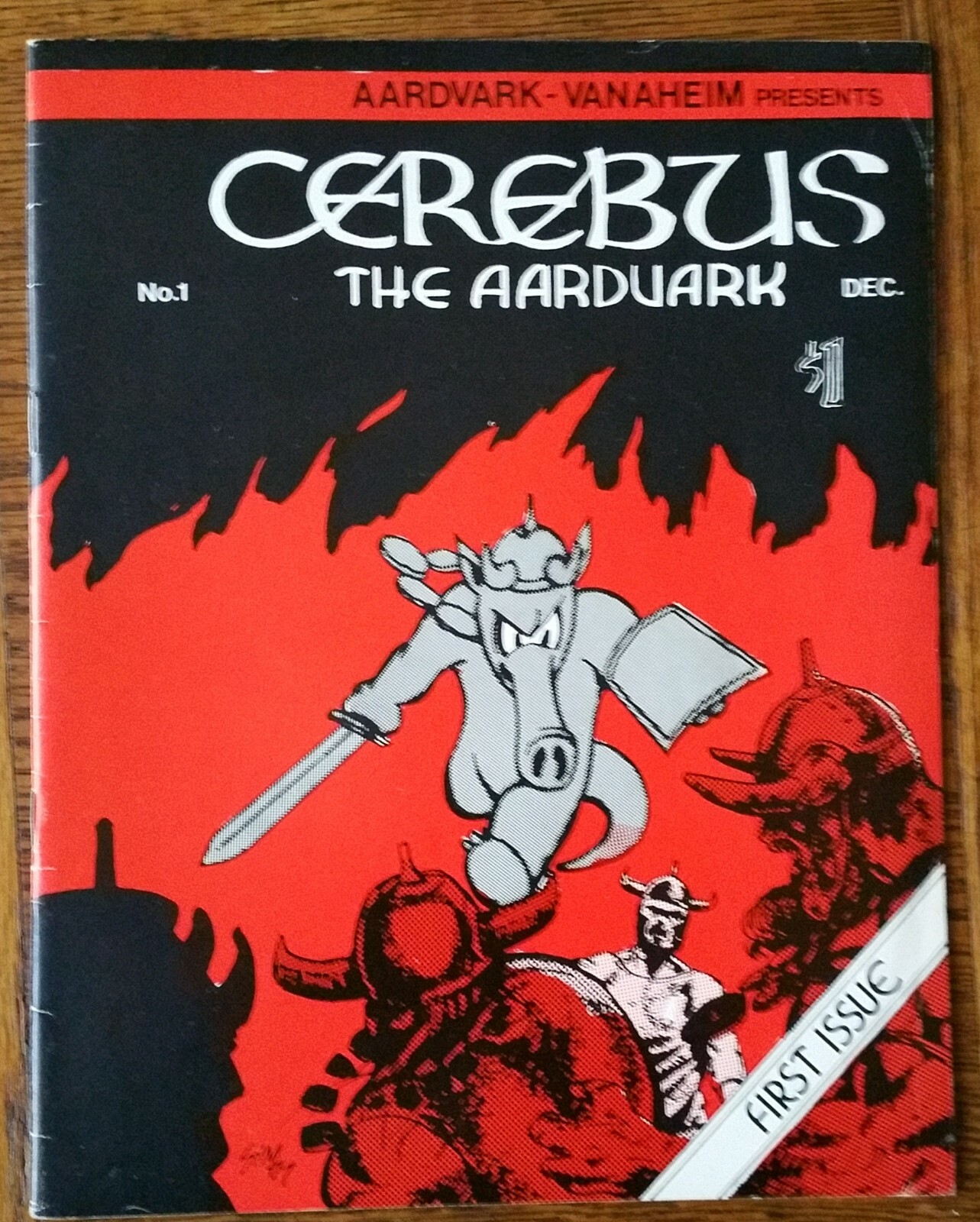
So you've got a lead on a Cerebus #1.
So you've bought a Cerebus #1.
Is it fake? Is it real? That is, is it actually one of the 2,000 copies printed in 1977 by Kitchener newspaper printer Fairway Press for the fledgling Aardvark/Vanaheim, or is it one of the (unknown printrun) sub-par counterfeit copies printed several years later by a (sort of) unknown unscrupulous person out to make a buck by fleecing comic collectors of their hard-earned cash? Are you bidding on a piece of history or a piece of infamy?
If you're actually holding both a real issue and a counterfeit issue in your hands, the differences are very easy to detect. But bidding on the internet, or just holding a random issue in your hand, it can be a daunting task.
Well, no more. Want to know if an issue is authentic, or a worthless stapled packet of newsprint? There's only one place on the cover you need to look.
 |
| Meet Floyd. |
Above: A closeup of an authentic Cerebus #1 cover. Click to embiggen. There's no real "trapping" of the red color, i.e. the red only overlaps the pure black areas a little bit. Notice the side of the arm of the figure—no "halo" of red leaking into the arm of the figure.
 |
| Meet "Pink" Floyd |
Above: a closeup of the same areas of a counterfeit Cerebus #1. Click to embiggen. Notice that the red is mis-registered, and leaks into the figure's arm, making a red "halo" in the inner arm, chest, and the medallion. Additionally, the red is "trapped", completely covering the medallion.
If you see an auction on ebay or any other online seller, ask them for a closeup photo of this area of the cover. If they won't comply, it's safe to assume they know they're knowingly selling a counterfeit of the book.
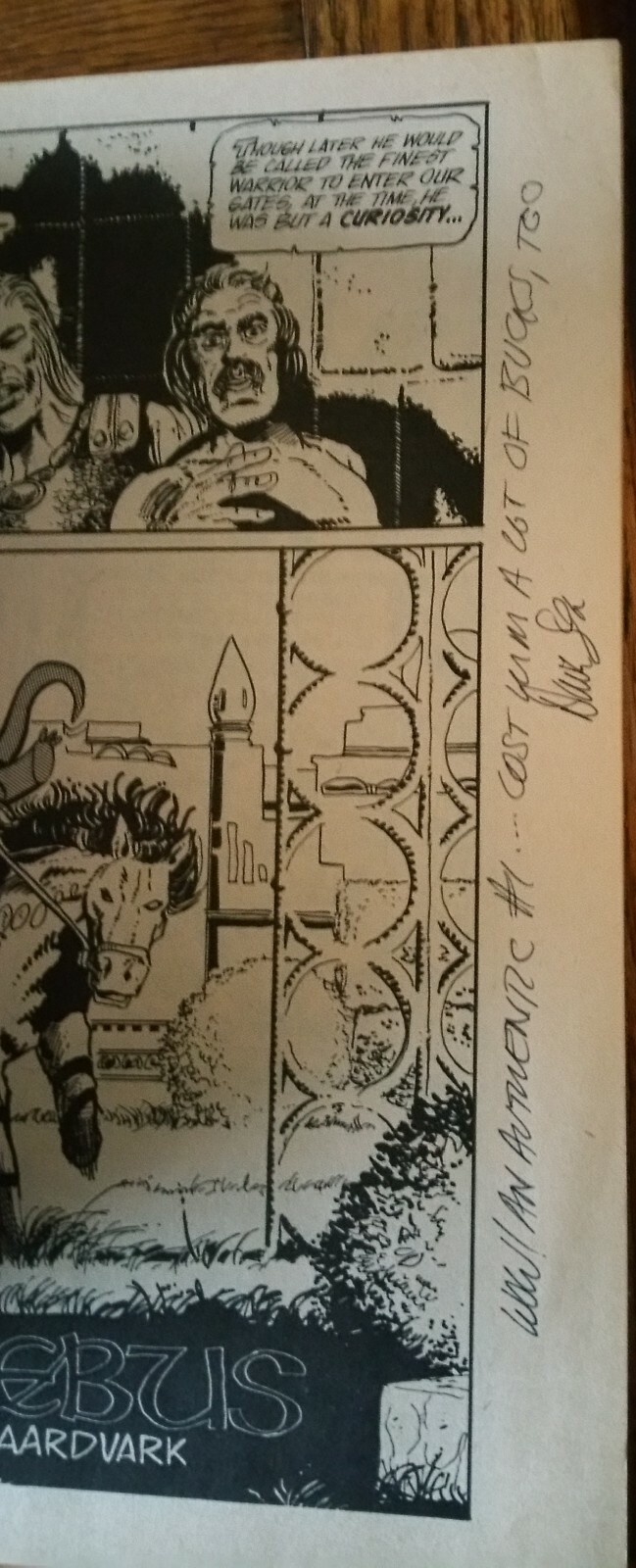
If you can actually see the interior of the book, there's an even easier way to tell. Turn to the splash page of the dragon and the wizard, page 16.
If the Cerebus figure on the bottom of the page is toned, it's an authentic copy. If the Cerebus figure has almost completely filled in to black, it's a counterfeit.
 |
| Real Vark |
 |
| "Quit checking out Cerebus' ass!" |
Above: a closeup of page 16 of the AUTHENTIC Cerebus #1.
 |
| Fake Vark aka: "Counterfeit Cerebus" coming soon(?) to a Cerebus in Hell? strip near you (next year, maybe?) |
 |
| "Counterfeit Cerebus doesn't mind you checking out his ass, he relishes the attention..." |
Above: a closeup of page 16 of the COUNTERFEIT Cerebus #1, with filled-in tone and washed-out blacks.
Happy hunting!
Okay, everybody say, "Thanks Sean!" Thanks Sean.
I mean I had my Cerebus #1:
 |
| Okay, okay...I admit it, it was a counterfeit. And delicious... |
AND...
I got this message TO Seiler FROM Dave:
7 August 18
Hi Jeff!
RE: your response on AMOC:
I hate to pick nits and scabbed-over wounds
simultaneously, but wasn't it Shecky McAssCRAP (no "e" on the
end?)? I was actually going to ask at
some point what the first name was. I remembered McAssCRAP but couldn't
remember the given name. Glad to hear
that your own Monkey Boy-name-shaming days are behind you.
Actually, it was ORIGINALLY "Slambo Asscrap," which I swiped from a print edition
of a webcomic, and then changed to "Shecky McAsscrape" once Seiler embraced it, and I was afraid he (or worse, me) would get sued.
1. The date on the counterfeit was 1977,
not 1982, so, yes, the intent to deceive and obfuscate was there.
2.
I'm hoping that there's general agreement that the metrics should be widely
available, but I don't think they are. I know from long (long, long, long)
experience that it's almost impossible to explain anything about CEREBUS to
anyone besides CEREBUS fans. Everyone
else seems to have built-in CEREBUS filters. Which is why I wanted the most
easily identifiable of those metrics -- Pink Floyd -- to be what we restricted
ourselves to. The longer the list of
differences, the more people's eyes were likely to glaze over and, in the case
of CGC copies, it has to be something you can see on the front or back
cover. The Monday after this was posted
to AMOC, Alfonso showed me a CEREBUS No.1 he had bought at a recent convention. "It's a counterfeit" I said while
it was still a couple of feet away.
This many years later on and with more experience at seeing the actual
Pantone WARM RED colour of an authentic No.1 than even most CEREBUS fans, the
pinkish cover colour is the giveaway for me.
But we can't use that as the metric because most people have never seen
a real No.1. Thus, the red ghost image
on the chain-mail and other black ink details on Pink Floyd is the best way to
a) identify a counterfeit
b) disseminate the way to identify a
counterfeit
As I said before, CGC KNOWS about the counterfeits, and grades them as such. I've yet to hear a credible story of a counterfeit that has been graded as real.
Particularly in this day and age where it's
a matter of pushing a few buttons to
i) take a high resolution photo of the
cover
ii) enlarge that section of the cover
iii) incorporate it into the seller's post
Unfortunately, you need to have a), b), i),
ii), and iii) happen simultaneously in order to improve the situation and I
don't think that's likely to happen which is why I'm sending you this letter
and having it e-mailed to Matt Dow later, so I can repeat my thinking and hope
that this time it sticks: that the scans
that Sean has taken of the genuine CEREBUS No.1 and the counterfeit, be made
available to any interested CEREBUS collector who regularly surfs the auction
environments online and that they (if they're interested -- I can certainly
understand them not being interested) get into the habit of e-mailing
the Pink Floyd blow-ups to anyone auctioning a CEREBUS No.1and suggesting that
they do comparable blow-ups of their own copy.
And "commenting" where possible on the inadvisability of
purchasing a No.1 where someone hasn't done so.
Here's the post. It has the label, "Floyd Pink Floyd" if any future post deals with this, it will have the label, "Floyd Pink Floyd".
3.
With any luck, we can make the, as you put it, "time-dishonored" approach of caveat
emptor no longer viable when selling a CEREBUS No.1 and, instead, replace
it with Ronald Reagan's favourite Russian proverb: "Trust. But
verify." There can't be, on any given day, THAT many CEREBUS No.1's
offered for sale, particularly relative to the number of CEREBUS collectors
regularly searching for CEREBUS material online.
You'd be surprised Sim, you'd be surprised...
4.
It shouldn't be the case, in an ideal world, that you wouldn't bid on a
CEREBUS No.1. If you WANT a CEREBUS No.1 and you're willing to pay the going
price for a CEREBUS No.1, questions about its authenticity, in 2018, shouldn't
exist. But that requires the active
participation of CEREBUS collectors to ensure. We can't properly infer that Tim
P. was actively misrepresenting his No.1 because there was no online mechanism
in place to establish its authenticity.
In effect, all the CEREBUS collectors stood around and stared at it and
did nothing. What I'm proposing is that CEREBUS collectors no longer do
that. That CEREBUS collectors make a
point of e-mailing Real Pink Floyd and Counterfeit Pink Floyd to actual sellers
and suggesting that they shoot a photo and enlarge it. If enough CEREBUS collectors did that so that
NO seller can ever again say "I don't know" about it, then a failure
to a) take the photo and b) post the photo can only be a tacit admission that
they're attempting to pass of a counterfeit as an authentic one.
If a Cerebus #1 ISN'T slabbed, then Black Cerebus and the Dragon should be the go to. But Floyd is workable too.
5.
Damian considers anyone a "pompous ass" who disagrees with his
political opinions. Which makes him
something of a pompous ass, by definition.
:)
This is gonna bring me trouble, I should just delete it, but that'd bring me trouble too. Before you idjits start "having a go" in the comments, remember your poor Interim Editor and that he's getting old and doesn't have the energy to referee your bullshit...
6.
Let me correct your misinformation here.
There were only 2,000 copies printed, yes, but they were virtually all
sold to two distributors, not three comic-book stores -- 500 copies to Jim Friel's Big Rapids
Distribution in Lansing, Michigan and 1,000 copies to Phil Seuling's Sea Gate
Distributors in Coney Island, New York -- and 500 copies to Now & Then
Books, the local comic-book store in Kitchener.
All of them sold their copies to any interested purchaser -- Jim and Phil
to the stores that they supplied -- and Harry Kremer to his own customers and
other Southern Ontario comic stores.
There was no secondary market in December 1977 and January 1978. By the time issue 3 was published, No.1 was
pretty much unavailable. THAT was when
the secondary market started. Deni and I
had, maybe, 50 of them to sell at conventions.
And I only remember having No.1 and No.2 in those quantities at one
Toronto show in early 1978. No.1 sold
faster than No.2 and when we were down to 20 copies, I said, okay, that's it.
We're bagging and boarding those 20 and putting them away. When Deni and I split up, part of her
settlement was that she got 10 of the No.1's.
There was a genuine kerfuffle when Harry
put a $50 price tag on a No.1 that he had reacquired. Which he did because he, more than most, knew
that they were hard to come by. He still
had a basement full of 5,000 copies of OKTOBERFEST No.1 and 2,000 copies of NOW
& THEN TIMES No. 1 and 2, both of which he had published, but after he sold
his 500th copy of CEREBUS No.1 it was a while before he saw one again. Too late
he realized that he should have put 20 of them aside when he still had 500 of
them.
A good chunk of the direct market were
underground people who saw that as profiteering. No comic book should ever be
sold for more than cover price. "Ground level" collectors tended to
see it the same way and tended to view anyone who sold comic books for more
than cover price as a really disgusting and sordid ghetto in the outer fringes
of the mainstream. I took a lot of heat
for not denouncing people for selling CEREBUS back issues for more than cover
price and for letting Harry advertise them in the back of the book. Hopefully, we're past that now.
Yeah, "hope in one hand"...
A few years back, a major Golden Age dealer
called in a favour from Pete Dixon asking if Pete could get me to sign a
CEREBUS collection he had bought and Pete called in a favour with me getting me
to do it. At the time, Peter (and his
then partner Kevin Boyd) was the only store owner who had signed the petition,
so he had a lot of cachet with me. And
still does. I asked him to phone the
dealer and find out if he wanted Neal Adams or Frank Frazetta on his No.1 -- it
was a counterfeit. And only found out
later that he had paid several thousand dollars for it (in 8.5).
I must assume that it was NOT graded and slabbed by CGC...
The "metrics" aren't as
"widely available" as CEREBUS fans tend to think. But, I hope -- one step at a time and with
the active participation of CEREBUS collectors -- we can keep situations like
this from occurring in the future.
Best,
Dave
PS:
Let me know when you get this in the mail so I can have Rolly e-mail it
to Matt Dow.
Which he did. And now you people get to read it. Like the man said, "We're MASS Communicating!"
Alright, Public Service performed.
Next Time: That Jingles thing Hobbs has been trying to post since whenever, UNLESS I INTERFERE AGAIN! MWAHAHAHAHAHA!!!