Showing posts with label Scott McCloud. Show all posts

Sunday, 19 January 2025

The A/V Family Photo Album: The last of the Northampton Summit photos

Hi, Everybody!

Continuing from yesterday, the LAST of the Northampton Summit photos


Next Time: Well, this is the last of the Northampton shots, so not that...

Saturday, 18 January 2025

The Northampton Summit: Part 2

Hi, Everybody!

I don't wanna do the post I WAS gonna do today, so TO THE AV FAMILY PHOTO ALBUM!

We return to

And the Northampton Creator Rights Summit:


Don't worry Mags, there's only 24 more pictures in this section...

Next Time: I don't know, depends on my mood tomorrow...

Monday, 30 May 2016

Distribution: "It's Just Business"

High Society Ad
Cerebus #86 (May 1986)
DAVE SIM:
(from Al Nickerson's Creator's Bill Of Rights Blog, 23 April 2005)
...The first draft of the Creative Manifesto [the precursor to the Creators' Bill Of Rights] was a communal effort on the part of Kevin Eastman, Pete Laird, Steve Bissette, John Totelben, Michael Zulli and Stephen Murphy and myself -- with supplemental input from Alan Moore, Frank Miller, Dave Gibbons, Steven Grant and others -- in response to Diamond raising the possibility of not carrying the Puma Blues because I was selling the High Society trade direct to Cerebus readers and not offering it through the direct market. Essentially the Manifesto was an attempt to determine what rights and obligations each level of the direct market "food chain" had in dealing with each other. This was the first time that a creator who was also a publisher had had a serious contretemps in dealing with a distributor. As a publisher, it seemed to me that what I had found was a "more direct market" which allowed me to make enough money per book to pay the largest printing bill I had ever had to pay up to that time. It wasn’t that I hadn't offered the book to the direct market -- I had -- but the direct market had ordered a very small number of copies, too small to pay the printing bill. In effect what they were saying was: we want you to assume all of the debt and make the books available to us and we’ll order them as we need them. Since the stores had always, in my experience, under-ordered Cerebus, it was an open-ended question as to how long it was going to take to sell six thousand copies of a $25 comic book through them. There were no $25 comic books being sold at the time and, much like today, virtually all of the retailers’ attentions were taken up with Marvel and DC so I decided to offer the books direct to the Cerebus readers and, as a result, instead of coming up short on the printing bill, I turned a $100,000 profit. It was particularly bothersome at the time because the distributors and the stores were always telling me "it's just business" when they would cut their orders or demand a higher discount or register whatever other complaint they had and use whatever leverage they had to make me toe the line. But when the shoe was on the other foot, they presented it as a loyalty thing. I was being disloyal to the stores by selling direct to my own readers. Well, why was it disloyal for me to sell direct to my readers when it was "just business" when the distributors would cut their orders or insist on a higher discount or demand that we pay shipping or whatever else? To me, I had made a no-brainer of a business decision. Go into debt to print the trade paperback and then sit and wait for the stores to order them two or three at a time or sell all six thousand in a month or so and turn a $100,000 profit. Basically, the universal retailer position was -- or seemed to be -- that I was obligated to sell them everything that I published no matter how few copies they ordered. I basically pulled Kevin and Peter into the discussion -- the only other self-publishers who were in the category of being a significant profit centre for Diamond -- as a means of determining if that was a valid criticism and, if it wasn't, to have more than just my own voice opposing it because at that point it was "Dave against everyone and everyone against Dave". The Creative Manifesto attempted to draw lines between what a creator-publisher could do and what he should do. It was entirely legal for me to sell my book direct to the readers, the question was: was it ethical to do so? I was giving the retailer position the benefit of the doubt: they might be right that I was behaving unethically, in which case I was willing to revisit the question but only if some consensus could be achieved as to where my ethical obligations to the retailers began and ended. In my own view -- since this situation had never come up before and was likely to come up again for future self-publishers -- I couldn't just cave in because it would establish a precedent that in effect would say, "A creator-publisher must always do what the retailers want no matter how unsound it is from the self-publisher’s business standpoint." If that was the foundation of the retailer position then I would have to argue strenuously on behalf of all future creator-publishers to keep from having the retailers use me as the template. "Dave caved in and gave us the books, so that means you have to, too. It’s how the direct market does business." Kevin and Peter understood what I was talking about and also understood that they had a lot more to lose than I did if a precedent was established since they were just beginning to branch out into the real world. What if the retailers decided that they had to be offered everything with the Turtles on it on direct market terms or they would stop distributing the Turtles comic books? That much retailer control was unacceptable to me and to Kevin and Peter, but how much control should the retailers have and how much control should the distributors have and how much should we have? The issue was a dispute about how business was conducted between creator-publishers and distributors and retailers. It became complicated because we had to dissect the problem into its component parts in a way that was nearly Biblical: "In the beginning there is the Work…" and then to follow the Work from the point of creation through to the time that it’s purchased by a consumer. The fact that Steve Bissette, a DC freelancer, came into the discussion early on meant that we got distracted from what we were talking about and drawn into a much larger discussion. I was willing participate in the larger discussion as long as the larger discussion also addressed the question of the borderline between creating, publishing and distributing. When Scott showed up with his Bill of Rights it made the process a lot simpler from my standpoint. All I had to do was to get a right included that said "We have the right to control the means of distribution of our work." That got watered down to "We have the right to choose the means of distribution of our work" which was fine by me. That was the answer that I had been looking for when the process got started. I had the right to choose to sell the High Society trade paperback direct to my own readers. Kevin and Peter promptly published a hardcover of the complete Turtles and sold it direct to their readers, helping to reinforce the point -- we have the right to do this. Because Scott was and still is a freelancer who has no contact with the distribution side he never understood that there is a meeting place between the creative and distribution side of the comic-book field if you publish your own work and that a line had to be drawn in the sand to keep the retailers and distributors from establishing rules that said that "creator-publishers must always do what retailers and distributors tell them to do."...

Monday, 15 February 2016

Larry Marder: Beanworld Self-Publisher?

Tales Of The Beanworld

DAVE SIM:
(from Patreon Update Bone & The Strange Death Of Alex Raymond: Part 10, 31 January 2016)
...I first met Larry at Petuniacon back in '84 in the fanzine BEANWORLD days and then again when he had quit his advertising job to do BEANWORLD full-time... and was, self-admittedly just not producing. Like Bissette with TYRANT: "My big chance to do my dream comic for a living!" and then he just froze. Inexplicable but far from rare. The IMPRESSION that he always left was of someone who intended to self-publish but, in retrospect, that might have been play-acting so he could be associated with self-publishing while not actually self-publishing. His next major appearance was at the Northampton Summit in '88 where he just sort of arrived with Scott McCloud -- which made me think, "Well, I know what LARRY is doing here: but what are YOU doing here?" And, of course, Scott waylaid the whole process of the Manifesto we were putting together, defining the boundaries where distribution/publishing/self-publishing overlapped and pulling that 180° over in the direction of a labour/management agreement from labour's side, his Creator's Bill of Rights. That really pushed me out of the picture, but all I had really been concerned about was the Right to choose how to distribute my work (i.e. sell direct to fans when that made more economic sense). Kevin and Peter had started publishing other artists and Richard Pini -- who was doing "work-made-for-hire” at WaRP -- was there. So I figured "Let THEM hash out the labour/management thing". Missing the point that without ME pulling all these people into the same room they weren't going to continue meeting. Kevin and Peter would continue to use work-made-for-hire on TURTLES work they didn't do. Richard Pini would continue to use work-made-for-hire on outside ELFQUEST titles, Kevin would start Tundra as a creator-owned imprint (I suspect to APPEAR to offset Peter's stricter work-made-for-hire way for the two of them to run Mirage). And Image would come along four years later portraying itself as the ideal of creator ownership -- and almost immediately the partners were hiring other creators to do (what I would consider) "their" work for them which the partners owned lock, stock and barrel. There's nothing ILLEGAL about work-made-for-hire, but it tends to be UNETHICAL: people ending up at the end of their careers owning nothing while their work continues to generate large sums of money. That was what I was trying to fix. Society has evolved in the direction of fixing that -- no one thinks anything of a creator selling a book on Kickstarter AND making it available later through Diamond. But no one foresaw that the Internet would STRUCTURALLY change everything roughly fifteen years later. Gerhard was never work-made-for-hire. He had the right to reproduce anything he worked on and still does -- Sean is under strict instructions to provide Gerhard with restored scans of any CEREBUS page he worked on and Gerhard has the right to reproduce it, which is what he does, paying A-V a courtesy royalty of 4% on sales of his prints. He could certainty sign a deal to do a GERHARD ART book without asking permission. If you worked on it, you have the right to reproduce it is my position -- and the agreement I have on TURTLES 8 and SPAWN 10, as an example. Gerhard was a definite (if you'll pardon the expression) Bone of contention at the Northampton Summit because my position was fully formed even then. Gerhard couldn't sign with Disney for a CEREBUS movie, but HIS work is HIS work and HE has the right to reproduce it. I was a dissenting contributor on the "We have the right to FULLY own what we FULLY create." For me it's “We have the right to reproduce and sell what we create.” Someone can draw Cerebus on a print and sell reproductions of it without asking permission because he or she created the print. It's really not a problem. The instances of someone doing that are anecdotal. There is no cost or cost to the copyright holder. Just a misapprehended mindset that if you don't jump on people with legal hob-nailed boots you risk losing ownership. The law profession propagates that myth for obvious reasons: they make (or used to make) lots of money from cease-and-desist letters. A kid drew an ELFQUEST character into a freelance art job for a crossword puzzle magazine. Richard saw it and jumped on the kid with hob-nailed boots and the kid was crushed and quit drawing for a living. The Spermbirds used CEREBUS on the front of their album cover "Something To Prove" and their t-shirts to this day. I don't see how CEREBUS or Dave Sim are harmed by that.

It was a Comic Art Metaphysics "Something To Prove" and I think I proved it and continue to prove it each time the band sells a t-shirt. 


In terms of Larry, I think that it was not uncommon to have an inaccurate self-perception particularly in terms of what both Larry and Jeff would have deemed "tribal matters" -- being both strong adherents of what I would call an "overly romanticized" First Nations view of the nature of Reality. Larry always referred to Comicon as "the gathering of the tribes," as an example. Most of BEANWORLD can be construed as Larry's inferences of Hopi Indian culture made into iconic narratives. Of course, Larry isn't a Hopi Indian. But that kind of cultural misappropriation -- which First Nations are beginning to "call out" people like Larry and Jeff on -- tends to lead to the idea that you are whatever you perceive yourself to be. "I self-identify as a native American" or, at least, NON-white, NON-European. If all that's required for self-identification is self-declaration then it isn't that difficult to say, "I self-published an ashcan for this convention, therefore I'm a member of the self-publishing tribe. Even though I'm really shopping for a publisher." Jeff has a more valid claim there, since he's published by Scholastic but self-publishes his own projects and the complete-in-one BONE volume. Self-publishing a behind-the-scenes book in violation of your Dark Horse contract JUST so you can call yourself a self-publisher seems... odd... to me. I don't think it benefits self-publishing because it creates a smokescreen which hides ACTUAL self-publishers behind semi- and demi- self-publishers. But I think that's the UNCONSCIOUS impulse behind it: the last thing the Feminist Theocracy wants is AUTONOMOUS MEN freely expressing creative political entertainment independent of the levers of feminist control: pressure on advertisers; pressure from editors and publishing executives; pressure from licensors.

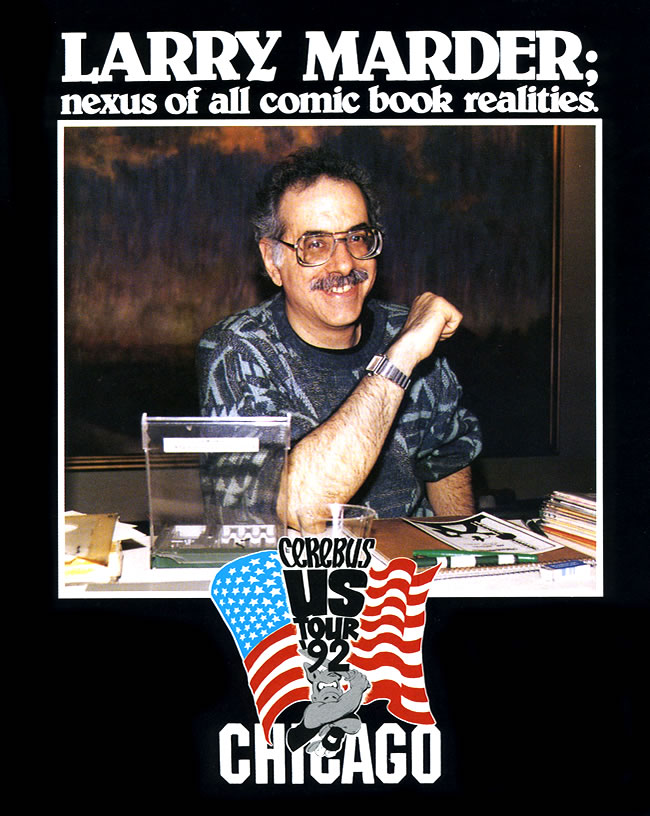
It's really Larry leaning on and trying to maintain his Nexus of All Comic Book Realities stature, which was true to a degree: he did fit in with a lot of disparate people. But, as I say, I think the self-publishing distinction is important because of the (increasingly?) potent threat posed to creative autonomy by the (increasingly?) restrictive forces of political correctness. I hope it's not too late to come up with a means of dissipating the smokescreen with a strictly defined SELF-PUBLISHERS ONLY website context (which I’m working on right now)... [Read more at Dave Sim's Patreon site...]
 Backcover, Cerebus #167 (February 1993)

Saturday, 6 September 2014

From The Archive: Understanding Scott McCloud

Understanding Comics (1993)
by Scott McCloud

"...an invaluable reference work about the medium...
...Entertaining, delightful, thought-provoking and innovative. Bravo!" 
~ Dave Sim
(from the back-cover blurb of the 1st Edition, Tundra Publishing, 1993)

DAVE SIM:
Treasures From The Archive -- Spiral bound draft copy of UNDERSTANDING COMICS by Scott McCloud along with extravagantly flattering cover letter looking for an endorsement. Of course, Scott would prove to be the first professional peer to publicly label me a misogynist (page 104 of REINVENTING COMICS). Which is one of the reasons that I never take flattery seriously. The ones blowing the most sunshine up your yin-yang when they want something are the ones that will stab you in the back the hardest when they get the chance, in my experience. Oh, well. At least I'll never be able to "pull rank" on him. Which I assume was the whole idea behind the turnabout.

Scott McCloud is a cartoonist and comics theorist best known for his comic series ZOT! and his non-fiction books about comics theory: Understanding Comics (1993), Reinventing Comics (2000) and Making Comics (2006).

Monday, 25 August 2014

Scott McCloud: The Eighties Generational Shift

Excerpt from Reinventing Comics (2000)
by Scott McCloud

Scott McCloud is a cartoonist and comics theorist best known for his comic series ZOT! and his non-fiction books about comics theory: Understanding Comics (1993), Reinventing Comics (2000) and Making Comics (2006).

Tuesday, 11 February 2014

Cerebus vs Scott McCloud's Zot!

Cerebus / Zot! (unfinished, 1991)
Art by Dave Sim & Scott McCloud
(from Cerebus #154, January 1992)
Scott McCloud's Zot!, published by Eclipse Comics between 1984 until 1990, was a lighthearted alternative to the darker and more violent comics that dominated the industry during that time. There were a total of 36 issues, with the first ten in color and the remainder in black and white. McCloud credited Astro Boy creator Osamu Tezuka as a major influence on the book, making it one of the first manga-inspired American comic books.

Sunday, 17 November 2013

Creators Bill Of Rights 25th Anniversary: Scott McCloud

The Northampton Summit Participants
Left to Right: Ken Mitchroney, Mark Martin, Michael Dooney, Steve Lavigne, Peter Laird (sitting)
Kevin Eastman, Ryan Brown, Michael Zulli, Richard Pini, Scott McCloud, Larry Marder
Dave Sim, Rick Veitch, and Steve Bissette. (Not pictured: Eric Talbot and Gerhard).
Art by Scott McCloud
SCOTT McCLOUD:
(taken from Scott McCloud.com)
The Creators Bill Of Rights was written in November 1988 for a two day "Summit" of comic book artists held in Northampton, Massachusetts. The meeting had been suggested by Cerebus creator Dave Sim and hosted by local heroes Kevin Eastman and Peter Laird, creators of the Teenage Mutant Ninja Turtles. The Summit was a follow-up to a July meeting in Toronto which produced a "Creative Manifesto." Some of us found the Manifesto a bit scattered, so I wrote a rough draft of a proposed replacement. That replacement, "A Bill of Rights for Comics Creators" was accepted quickly at Sim's suggestion. The rest of that day was a non-stop argument about the document's wording.

The Bill never generated much noise in the industry and I wouldn't want to exaggerate its influence, but it provides an interesting snapshot of our attitudes at the time, and of the climate that was fueling self-publishers, progressive business people, and artists trying to reinvent the comics industry. A few years later, several top-selling Marvel artists would break from the pack and form a new company called Image, shifting the debate from rights and principles to clout and competition, but both developments would share a common premise, still relevant today: that comics creators already have the right to control their art if they want it; all they have to do is not sign it away.

I was invited in large part because I knew Laird and others through an APA I'd created called The Frying Pan. At my suggestion, Beanworld creator and "Nexus of all Comic Book Realities" Larry Marder was invited too. Larry flew out from Chicago to our place in Arlington, Massachusetts shortly before the meeting. I had the rough draft of the Bill ready but not typed yet. I vividly remember hammering it out on my old manual typewriter as Larry read my notes back to me, right before we rushed out the door to catch a succession of buses and trains to Northampton. While waiting for the bus in Springfield, we found a copy shop and photocopied my hastily typed hand-out. It was also on that trip that I showed Larry my notes for a comic book about comics that I had been working on for a few years.

After the first day of debates, everyone stumbled out of the Hotel Northampton into the cold New England air to walk the five or so blocks to dinner. I remember Larry and I lagged behind a little. I had argued with Dave Sim about every imaginable issue that day as if my life depended on it, but walking to dinner, it all seemed pretty distant already. Larry and I talked more about my notes for the comic book about comics. I asked him if he thought those ideas would mean a lot more in the long run than anything I could accomplish in Northampton. He said yeah, they probably would.

When those notes became Understanding Comics it was Kevin Eastman's money that paid me to finish it - money he and Peter had earned because they refused to give away their creation the way so many artists had before them.

Scott McCloud is a cartoonist and comics theorist best known for his comic series ZOT! and his non-fiction books about comics theory: Understanding Comics (1993), Reinventing Comics (2000) and Making Comics (2006).