Showing posts with label Comic Book Greats. Show all posts

Tuesday, 18 December 2018

Intro by Dave: "Dorks of the Tower"


Hi, Everybody!

Hey Look! It's Dork Tower by John Kovalic:

Image result for Dork Covenant

DORKS OF THE TOWER
"Hey, Marcia. Come and see the satanist."
  That one still cracks me up.
   I have no great affection for gaming, but then I'm always suspicious when a noun becomes a verb without warning. Like "party". It is interesting to me that, right around the time-that "party" became a verb (I party, you party, he/she/it parties, we party, you party, they party), what it was describing had actually ceased to exist and the sort of characters that Kevin Smith has made a career out of documenting had taken over. In my day, when those fellows too over the keg, you knew that you should have left half an hour ago.
   You might well ask what has this to do with John Kovalic and his excellent comic book, Dork Tower.
   You might well ask what is wrong with the characters that Kevin Smith documents?
   You would ask in vain, however, for I confine my closely reasoned arguments to the back pages of Cerebus.
   Uh. Cerebus? The comic book that I draw?
   Yes. Yes. Twenty-three years now (almost). A little over three years to go. Pardon? Yes it's one long story that I started in ... Science fiction? No, no. It isn't really a... well, Cerebus did do a tour of the solar system in one of.. Fantasy? Uhh. Yeah. I mean, not as much as there was early on when it was mostly a Conan parody. Conan. Well, before the movies, Conan was a ... No, I'm not really interested in Hollywood myself. You mean, like a Cerebus animated cartoon or something? No, I really... Well, the loss of control. See, when you sign a contract with a studio, they... Pardon? Well millions of dollars if everything goes right. But, you see, it only goes right once in a great while. Like with the Teenage Mutant Ninja Turtles, but then you have to stop writing and drawing and become the CEO full-time of whatever you... Well, I don't know how many millions the Turtles made, exactly. But millions and millions, yes. Definitely... See, to me, when you self-publish your work, as I do with Cerebus and as John Kovalic is now doing with Dork Tower, the idea is to reduce the amount of outside interference and to limit the business side to turning the artwork into printed comic books and getting them to the...
   No, comic books. The ones in the newspaper are comic strips.
   Yes, it was very sad that Charles Schulz died.
   JOHN KOVALIC GOT A LETTER FROM HIM ONCE.
   Yes, that's right. The Charles Schulz. Oh, many millions of dollars ... maybe even a quarter of a billion.
   Yes.
   Yes. It is hard to imagine, Well, I think what impressed John was more the quality of the strip and that was why getting a letter fro its creator was such a big deal to him... why he has the letter framed and up on his...
   No. A lot of cartoonists do that, but Schulz didn't have ghosts. He wrote and drew and pencilled and inked and lettered every Peanuts strip that ever...
   Yes, wasn't that great? Yes, I watch it every Christmas myself. And when Linus goes out into the spotlight and starts reciting from Luke's Gospel...
   Well, it was first aired in 1965, so I guess it's made a lot of money since then. I don't really know how those things work. Whether the studio paid every time it's aired and pays Schulz's estate (now), or if someone bought the rights to it, you know, some big corporation like Time-Warner or ABC or something offered a lot of money for it at some point and Schulz (or whoever owned it) just decided...
   A Dork Tower movie?
   Well, I don't know. See, that's one of the funny things with self-publishers. Some of them are interested in Hollywood and some aren't. It seems to me that you don't really know which one you are until you get an actual offer from...
   ... Pardon?
   Well, I did--years and years ago--get a call from Lucasfilm... Yes. Star Wars. Definitely. Star Wars has made millions and millions of dollars... Well, no, just the one phone call. As I said, I'm not interested, so, you know, there wasn't much reason for them to call back. Regret it? No. No, uh, exactly the opposite.  As I said, I don't really have any interest in Hollywood. As I said, the loss of control just...
   Danny DeVito as Igor?
   Well, Danny DeVito has got to be... what? Late forties, early fifties by now. I always got the impression that the characters in Dork Tower are... Well, yes, you're right. There are gamers who are in their late forties and early fifties. Yes, that's true. If you have characters of different ages, they do like that in Hollywood. Hit the different demographic groups. You could cast same hot twenty year-old as Matt and get that older brother-younger brother thing. Make Igor the sloppy one and Matt the neat one. Yeah, like the Odd Couple. No, no--exactly. The first Odd Couple movie or even the Odd Couple television show. Or you could make Matt a girl. Jenna Elfman and Davvy DeVito. Wouldn't that be something? Yeah, they're both really funny.
   Speaking of really funny, have you ever read Dork Tower? The Dork Tower comic book? No?
   You really should.
   Yes,
   Yes, it is.
   It's very, very funny.
Dave SimKitchener, Ontario
3 June 00

Dork Tower #9 (2000)
Art by John Kovalic & Dave Sim
(Also, "AARVAK VANHEIM"?!?)

Man, that was a bitch to transcribe...

Next Time: Hobbs! You're up!
Monday, 17 December 2018

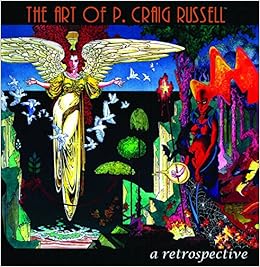
Intro by Dave: "The Singing of P. Craig Russell a short introduction by Dave Sim"

Hi, Everybody!

Hey Look! It's P. Craig Russell:

Image result for The Art of P. Craig Russell 

The Singing of P. Craig Russell
a short introduction by Dave Sim
The question arises -- as it often does -- alongside the "Art of..." volume: How did P. Craig Russell come to be one of the great unsung heroes of the comic-book field? As you are about to bear witness, it is an illustrious and near to flawless career that goes back thirty years -- more than thirty years. 
Don't take my word for the longevity, though: there's a photo herein of Craig with Don McGregor ca. Killraven, War of the Worlds (first taste of the margins of comic-book stardom, what Gil Kane described as the "small fame" of comics). 
Might as well ask: How did 1974 come to be thirty years ago? 
We owe, as it turns out, a debt to Dan Adkins and his studio (as, in turn, we owe a debt to Wally Wood for Dan Adkins), a tip of the introductory chapeau to CBG back when it was still TBG, back when the weekly cover slot was often a first stepping stone to prominence, to making a name for one's self or...to becoming unsung. 
The readily identifiable style arrives full-blown on page 30 and, after that, it's a relentless parade of "eye candy", sufficient to induce the ocular equivalent of a sugar rush. 
Why didn't we hear more about this stuff a) at the time b) in the interim and c) since? The perhaps more apt question: Why didn't we say more about this stuff? Then the personal self-indictment: When was the last time I mentioned Craig's work in conversation? I had worked P. Craig Russell and "Therimbula and the Sea" into Going Home (page 186). Metaphorically, I posed the question to myself: What could an archetypal Princess Diana and a F. Scott Fitzgerald derivation have found common ground in discussing, had they been contemporaries? He, urgently desirous of getting on her good side, she, wary of his alcoholism and the egregious theatricality of his marital woes...the answer was immediate. 
Night Music by P. Craig Russell ("I aDORE Therimbula and the Sea"). 
I didn't write to ask Craig's permission. With some people you would have to: you would be taking your life in your hands using something of theirs without a signed contract. With Craig (I knew) all I would be doing is spoiling a nice surprise. 
Wonder Woman on page 38...Tom Swift 3000 that became Robin 3000...how did I miss that one? Why wasn't everyone...singing...about it? 
An amazing collection. He's even an accomplished book designer. He hasn't got his photoshop pilot's license, but peering over Joe Pruett's shoulder he calls his plays right at the line of scrimmage. That Robin 3000 cover would look great at the top of that column of type. 
And it does. Of course it does. 
...The National Library Association poster (lucky Association!)...The Spectre covers (how did I miss those Spectre covers?)...the house on the first page of Gone...the Insomniac page...the "up shot" of the house in Coraline...Shere Khan on page 106...Chapter 7: Opera (will there ever again be a comic-book creator with a chapter of his "Art of" book devoted to Opera?)... 
Weighty subject matter? By contrast with Craig's contemporaries? To be sure...but leavened with acerbic wit worthy of an Upper West Side cocktail party. "Here's your share of the artwork." I can't remember when I've laughed so hard. 
What Craig needs isn't an introduction by the Pariah King of Comics (what was he thinking? Make no mistake, the loyalty is appreciated. Craig is no fair weather friend like so many in the field, but...what WAS he thinking?). 
What Craig needs is to have Jill Thompson in her Brunhilde helmet to ride Lucky the Horse right down to the footlights...stage center...to extract...with harsh metallic theatricality...her sword from it's scabbard...to then brandish it... 
"P......CRAIG.....RUSSELL!" 
She would cry (a fortissimo)...her gaze and her sword point then passing slowly from right to left...then from left to right...the crowd, a deer in Jill Thompson's metaphorical headlights...letting the moment build to a climax... 
And then...to the opening strains of Twilight of the Gods (gotterdammerung)...the row of white floodlights behind her shoot skyward... 
'EVERYBODY! SING!" 
Oh, well. This will just have to do.
Dave Sim
Kitchener, Ontario
11 June 07
Which was my 28th birthday.

Going Home page 186, courtesy CerebusDownloads.com 
Next Time: Dorks.

Saturday, 15 December 2018

Intro by Dave "BOB BURDEN: The Man Who Proved the Earth is Flat"

Hi, Everybody!

Hey Look! It's The Flaming Carrot:

BOB BURDEN
The Man Who Proved the Earth is Flat
by Dave Sim
Snapshots in the eighteen-year kaleidoscope: Marching to the beat of an indifferent drummer.
 
"I know how to fly- even if it is straight down." Is Bob Burden a position or a vector? Is the carrot-on-fire the beacon on the hill or a first glimmering of the devil's eye socket glimpsed behind the infernal gates? "I need a bigger bucket or less sand." In Alan Moore's Thought Space, Bob Burden is the migrating bookmark, selling mercury leashes to unwary periodic-table owners. "Look- it's a miniature Abraham Lincoln." "Aww- he's so cuuute." The universe is askew, but it never knew how to tie a decent Windsor knot anyway.
 
Flash forward to the present. A Flaming Carrot movie? Picture Eraserhead sensibility with "Animal House done with super-heroes" as the template. When Bob Burden is a position, Hollywood is a vector. "What's you vector, Victor?" I can't see anything, says the candy store with it's nose pressed up against Bob's glass. 
[picture of a flying saucer] 
To the new reader: you're either going to "get" it or not. No elitism should be inferred. Bob Burden's Flaming Carrot exists in a comic-book no-man's land that will put you under only if you had the right kind of breakfast this morning.
 
As with any creative work, the Carrot is out of Bob's hands once it is done. I look through the eyepiece, and each successive work moves into and out of focus- sharp, an almost excruciating clarity, then soft, indistinct. Everyone has an eyepiece, but Bob's the one doing the adjustments. I don't know what it is Bob sees. I. Do. Not. Know. What. It. Is. That. Bob. Sees.
 
As a host of angels disco dance on the head of a pin, an insanely dressed super-hero eats lunch at the bowling alley, while in the background: kissing dogs, a woman breast-feeding a dictionary, a baby-headed politician, and the assassination of the leading members of the Chihuahua In A Teacup Fan Club! The chair is not my son!
 
I. Do. Not. Know. What. It. Is. That. Bob. Sees. Call it "Bob's Burden."
 
Bob's Burden.
 
In person, this mercurial talent's personality and appearance are like the Van Allen Belt around the terra firma- the largely terra incognito- of his glimmerings of genius. He was once described as Dr. Zhivago and Gabby Hayes rolled into one.
 
He shifts his weight sideways in a chair in a honky-tonk bar, clearing his throat with a rumbling sound that calls to mind the phrase, ancient of days ("I've been around the block so many times, I feel like my turn blinker got stuck"). The band blares out a dubious rendition of "Reverend Blue Jeans" that sounds like Perry Como on crack. We are surrounded by the kind of people who'd rather curse the darkness than light one candle. Gerhard is talking to a woman with lipstick on her teeth and a dress that looks like it was just hit with a dessert tray.
 
Bob cannot be kept on the subject. "I'd rather pay retail than go through this." "Suggested retail?" "Yes." Is he talking about the band or the conversation?
 
Ionized particles coalesce behind the cool, brown-gray eyes as his inquisitor (me) tries to corner him on a specific point. Even as the argument's endgame reaches its climax, the last avenue of escape closed off, the radiation flares, and he says, "You see that girl at the table over there?" And he relates an anecdote- something written about Thelonius Monk, or something William S. Burroughs said to him in a dream. The story seems to end, but I'm left wondering who really put the overalls in Mrs. Murphy's chowder. I eye Burden suspiciously. A sudden insight dawns- like white sheet lightning on the horizon- that anecdote applies to the discussion. Tangentially. No- not tangentially, but rather it inhabits the authentic core, is a thematic distillation, a small key, a cake with a sign that says "Eat me"; it is a rocket-powered pogo stick that has carried Bob to safety. ("Yes, Mr. Death...I'll play your game! But not chess!!! Bah...Fooey! My game is WIFFLEBALL! HA! HA! HA!")
 
One gives up. But only temporarily. Even as you walk away from the chessboard, you cant's shake the feeling that whiffleball makes more sense. Bob was telling me something- or, more exactly, something inside Bob was telling me something- and I'm just too stupid to see it. 
[picture of a flying saucer] 
Scene 18- "The Making of 104: Ten Days that Shook Atlanta"
 
Ext. The Back patio of Bob Burden's Atlanta estate. Bob is seated at a card table with a manual typewriter of 1903s vintage. It is a clear, warm day in late October.
 
ME: (operating the video camera) Look. It's Bob.
 
BOB: (wary, squinty-eyed) Good morning.
 
ME: Whatcha doing?
 
BOB: (clearing his throat noisily and getting up) Writing a script for the next issue of the Carrot. (sits down again, reads) "Flaming Carrot! Flaming Carrot! You better come quick! Uncle Billy's new mail-order bride arrived and she's a...WILD WOMAN!" (standing up and indicating his shoes) Pan down and get a shot of these.
 
ME: Very nice. What are they?
 
BOB: Penny loafers. With Canadian nickels in 'em.
 
ME: In honor of our visit?
 
BOB: In premonition of this visit These have always been there! For fifteen years I've worn Canadian nickels in my loafers. Good things come to those who watch and walk around...
 
ME: Well, sit down. Let's get a shot of you writing.
 
BOB: (sits down) Let's...see here. Page 29. "Hey! It's that crazy dame again!" (begins typing)...the Jungle Girl jumps down and hits the bad guy and says...she s-a-y-s..."Gwaloompas Go Away" (smiles broadly at the camera) Hey! Why not? (types it furiously, smiling the whole time)
 
In the final version (issue 18), the Jungle Woman says, "Gwaloompas pugi! Go Away!!!" Bob's Burden. Why is "Gwaloompas Go Away!" wrong and "Gwaloompas pugi! Go Away!!!" right? It is no small matter, though the reader can be forgiven for thinking it is. Bob's Burden. In the realm of the surreal, where even the term surreal is inadequate, how do you know when what you're doing is right? Insight, instinct, gut reaction, craft, winging it- all wrestle together at the doorway of creation. And after that comes the reaction, and Bob's reaction to the reaction, and Bob's reaction to Bob's reaction to the reaction. But all I have is my eyepiece, and Bob's the one doing the adjustments. Bob's Burden 
[picture of a flying saucer] 
 Bob has finally consented to allow the early issues of the Carrot to be reprinted. For at least ten thousand people in the comic-book industry, we are finally (finally) able to stop breathing through straws from below the surface of a pond. What does this bode for our industry? Commenting on these times, Bob reminds me that if you graph the incidence of Flaming Carrot publications and compare it to the comics industry's health and volume over the last fifteen years, there is a direct correlation. When this information is then set against the statistics of sunspot activity, UFO sightings, and the number of women reported to be seen wearing rubber dresses in the Balkans, you have more than ample proof of the one conclusion we can draw from these specious but interesting facts. Within these calculations, he claims, lies the secret formula to a legendary, fifth basic food group he has referred to all these years as the source of his arcane creativity. "Wild horses will not drag the secret from my lips; a thousand dollars will not by it. But since you freely gave me the most guarded secret of all Aardvark-Vanaheim, the secret of Gerhard's last name..."
 
As he leans over to whisper in my ear, my mind scours the clues. Like Citizen Kane's Rosebud, it all makes sense to me. Life is a circle. The rise and fall of tides. A whispered secret from lips that have always been a mystery even unto the owner of the lips. A secret I have always known but always wanted to know better. A secret whose clues lie in pages and pictures. 
[picture of a flying saucer] 
 It looks like the Flaming Carrot is getting ready...I think I saw him getting up...you always say that...no, really, I think he's really getting up this time...he's moving around- he hasn't moved around in a while...that's gotta be a good sign, right?...you would think so...I'll believe it when he actually gets up...maybe we shouldn't talk about it- maybe talking about it is the problem...he's getting up...yeah, right...he's moving around more than...no, look...
 
LOOK!!!
Copyright 1997 Dave Sim
 
Reprinted by the permission of Sponge Boy


 Next Time: Sunday!


Saturday, 20 January 2018

Cerebus in Matt's Life: Part the Third

Hi, Everybody!

We now continue the bold saga of how Interim-Editor Matt Dow came to know Cerebus The Aardvark... um...ya know, not biblically, or anything weird like that...(for that kinda thing, see Cerebus in Jeff Seiler's Life... If. You. Dare!!!)

When last we left young Matt, it was May, 1993.

And now we flip the switch on the Wayback Machine, and travel the Circuits of Time all the way to...January 1993.

Young Matt had started to groove on Spawn and Wizard Magazine.

Wizard, the Guide To Comics, had run a number of bits about Cerebus and his creator, Dave Sim.

(I remember at one point, Wizard had instituted a "this month in comics" feature on their last page. One December it was about the first issue of Cerebus in 1977. Dave told the story of him and Gene Day at Gene's studio. Dave drawing Cerebus #1, and Gene doing a story called "Days of Future Past" (no, not the X-Men one...). Both with horrific head colds. And they ended up back to back at their drawing tables, with a thirty gallon garbage can between them and they just kept drawing and filling the can with kleenex... Wish I still had that issue of Wizard...)

AND, in the January 1993 issue (#29) Wizard did a year in review. And part of their review, was a preview of the far flung future of 2003 (dun Dun DUN!)

Wait for it...
See? Right there? Ya see it right?

This becomes important much later in Matt's life.

Now, I know what you're thinking, "Gee Matt, every episode of Scooby-Doo IS exactly the same. How DID it manage to last for so long?" 

Wha? You're NOT thinking that? 

Weirdos...

Anyway, it's a funny article. Funny, because as WE ALL KNOW, Cerebus DIDN'T end in 2003. It ended in March, 2004. And Cerebus didn't have a brother. 

But it planted a seed in Young Matt's little brain that grew into...(see Cerebus in Matt's Life: Part the Sixth(?), you'll see...)

Anyway, anyway, a few years later (I wanna say...199...8?), Matt's good friend, Nick AKA: The Comic Book Man (so called because he lends Matt comics by the foot. Seriously, by the foot. At one point, he lent Matt three feet of comics,) lent Matt the first five volumes of Cerebus.

And Matt read them all in a day and a half, returned them and said, "those were neat, got anymore?"

And Lo, the Comic Book Man haveth not more Cerebus, and Matt hadth to buyith his own Cerebusth, uh, Cerebus.

Yeah, and then Matt started to buy the monthly book.

And there was much rejoicing!

Next time: Matt Meets Dave! (And Ger!!!) WHHHHHAAAAATTTTTTT!?!?!?!?!?!?!


Saturday, 13 January 2018

Spawn in Matt's Life part the th...WAIT A MINUTE!!!

Hi, Everybody!

HOLY CRAP! Are we STILL talking about Spawn?

Yes, Matt, yes we are...

So, I faxed to Dave, and asked if he still had the Spawn #10 script in the Archive.

And he responded:
I'll see what I have in the Archive on SPAWN #10. Not much. The original script was auctioned to benefit the CBLDF -- and went for a few hundred dollars, as I recall -- so It's out there somewhere. WHERE is another question. 
I then asked if he put in the script whose arms were whose, and explained that we couldn't figure it out. He said:
Oh, I see what you're driving at. I did a sketch of Spawn with the prison bars in the foreground and super-hero arms sticking through. I think I would have done Batman's scalloped gloves and maybe Thor, the Thing? and then just generic gloves and gauntlets as a shorthand for Todd: "These are or can be actual characters' arms". What's Todd's level of interest in what I'm saying in the story? The more they're actual characters' arms, the sharper the political point that's being made. The less they're actual characters' arms, the less sharp the political point that's being made. 

An interesting question would be "How much of a point did Todd make of it with Steve Oliff as his colourist?" Drawing the arms is one thing but, unless you have the right colours on there, the point is going to be lost. Was Todd engaged enough to say "Steve, let me know if you need me to identify colours for you on any of these"? Try looking at the arms both ways: who they could be in black and white and who they could be in colour. 
So, checking what Margaret has said about it.  There weren't any sketches there.

But in Spawn #9, there is a sketch:
Copyright...Todd McFarlane? Neal can't claim to own this, can he?
It looks like a Todd sketch, not a Dave sketch, but I'm no expert. Anybody know better?

So here's the guesses as they stand:

#6: Electro in colour, Human Torch (flamed on Jeff...F.F.S.) in black and white
This whole Spawn thing is turning into a dangerous rabbit-hole for me. Each new answer raises more questions: Erebus, the level of Hell Spawn goes to in #10 gets mentioned in #8. That sketch appears in #9. Did Dave get his script in before Moore and Gaiman? Did he get copies of their scripts? Did Tom Orzechowski (the letterer and editor of Spawn) put Erebus in #8? Were all four guest scripts written and turned in before Todd started drawing? When will this ever end?

Next time: Great Googley-moogely there's GONNA be a next time isn't there?

Saturday, 6 January 2018

Cerebus in Matt's life: Part the Second

Hi, Everybody!

We now continue the examination of how mild mannered Interim Editor Matt Dow came to accept Cerebus the Aardvark into his life...

When last we left Matt, his was getting his Spider-Man on! (Thwwipp thwwipp!)

Around 1988, an actual comic book store opened in the next town over from where Matt was living. At first just a bunch of tables with longboxes outside a storefront at the mall, Powerhouse Comics soon became the place Matt wanted to go anytime he had money.

Cut to May 1993, Clinton was President, Mulroney was Prime Minister, and Matt was thirteen years old. And buying as much Spider-Man as he could get his hands on (which is how I got Dan Slott's first Spider-Man story,). That same month, Matt's friend Kevin (remember Kevin? Here's some columns by Kevin...) told him that Spider-Man's hand showed up in Spawn #10. 
First person to correctly name all those hands wins. What? I have NO idea...

How could that be? Surely Marvel was gonna sue Todd's ass off for this
BLATANT misuse of  Spider-Man's right hand? Matt had to own what was sure to be a rare and collectible piece of comic's history.


Reading the story, Matt encountered that little grey guy again.
In the 90s, you could still smoke in comics...
Who was that guy? 

What was his deal?

And why did he hang out at Peter's Place?

Unfortunately, those questions would have to wait a few more years...


Next time: The Comic Book Man cometh...

Monday, 27 November 2017

Cerebus In Matt's Life: Part the First

Hi Everybody!

Today on A Moment Of Cerebus, we look at the FIRST time mild mannered Interim Editor Matt Dow encountered Cerebus the Aardvark...

We set our Wayback machines to 1982. Reagan was President, Trudeau was Prime Minister, and Matt was three years old.

His dad had gotten him, and his older brother Ben (Hi-ya Jerkface!) a subscription to three Marvel comics (I think it was one of their frequent subscriber deals...), Star Wars, The Incredible Hulk, and...

The Amazing Spider-Man. (Matt's love for the wall-crawler is what led him to discover and first read Cerebus around 1993...)

And there, in the October cover dated issue:
Image copyright 2004 Marvel, see it says it right there. Not to spoil the issue, but Spidey fights the Tarantula. It does not go well.

Matt found the character that would one day consume him (wait, what?):

Of course, at three, Matt couldn't read the ad. But through sheer determination (and older brother Jerkface's refusal to read the story to our little hero,) Matt slowly learned the skill for which he would be must frequently told to, "stop that and finish [insert random task here]!": READING!

Soon the forty or so comics in the Dow brother's collection (carefully and lovingly stored in an old shoebox,) were read almost to shreds. The stories memorized. And so, young Master Dow began to go back and read the advertisements. (Because, seriously, who the heck WANTS to go out and pick dandelions?) 
CEREBUS
Cerebus is an aardvark, just 3 feet tall, tough as nails and ready to lick any 5 men. His stomping ground is the world of swords & sorcery. And if there's trouble, especially involving gold, he's smack in the middle of it! 
Short supply, don't delay! 

Who was this CEREBUS? What's an aardvark? And why was he ready to lick any 5 men?

A quick trip to the encyclopedia, proved fruitful. Aardvark's are ant-eaters. They use their long tongues to lick the ants out of anthills. Where the 5 men come into it, the people at World Book decided to leave out. Surely, it would be educational to find this Cerebus and learn more.

Unfortunately, at a dollar fifty apiece, purchasing these strange funnybooks was out of the question (not even the complete set of issues 23-38 for 21 bucks (a savings of $3!!!) was a consideration...).

If only Matt had done chores instead of rotting his mind with that funnybook trash! Wertham was right!!!

Next time: With Great Power comes an unhealthy obsession with a man who leaves the house in nothing but his long underwear... 

Monday, 18 January 2016

Comic Book Greats #5: Bill Sienkiewicz

Art by Dave Sim
(Glamourpuss #9, September 2009)

DAVE SIM:
(from 100 Internet Tour at Comic Book Resources, Febuary 2008)
...when I brought up Bill Sienkiewicz's STRAY TOASTERS at lunch the one time and you'd think I'd shot somebody's dog from the way Seth, Chester and Joe reacted. I reread STRAY TOASTERS at least once a year. It's confusing as heck but, for me it has some amazing moments... but then I like the illustration schools represented in there and what Bill is trying to do (or what I think Bill is trying to do). The use of flat colour in the lettering and the caption boxes which puts everything on TOP of the actual art. That's pretty breathtaking for me as an artist who is known as an innovative letterer. I take my hat off to anybody who can introduce a whole new way of doing work. Dave McKean came out of that. Thematically the SANDMAN covers are Sienkiewicz. Even if it's not your cup of tea, it's nothing to act as if liking it is the same as shooting someone's dog. GASOLINE ALLEY has very, very little to offer me, but I would never call it s--t...

Monday, 11 January 2016

Comic Book Greats #4: Neal Adams

Art by Dave Sim
(from Glamourpuss #1, April 2008)

DAVE SIM:
(from Following Cerebus #9, August 2006)
...He had been a guest at the first comic book convention I had attended in 1972, Cosmicon in Toronto. I had had no problem talking to Jim Steranko or Joe Kubert or Gary Morrow when the opportunities had presented themselves -- as if I had known them for years -- but at one point Neal Adams had been walking through the Dealers' Room, unattended and at a leisurely pace, and I had just watched dumbfounded -- I'm sure with my mouth agape -- as he walked past me. The convention had been held at Winters College on the campus of York University, and part of the set-up had featured six classrooms upstairs dedicated to displays of original artwork by the attending artist guests. Neal Adams' room was literally wallpapered with the original artwork to "No Evil Shall Escape My Sight" (Green Lantern / Green Arrow 76), "What Can One Man Do?" (Green Lantern / Green Arrow 87), "Night Of The Reaper" (Batman 237) and a couple of other stories and as-yet unpublished covers. I could feel my brain detaching from my body and doing backflips just standing in there looking at those pages. I literally had to leave to recover my equilibrium. That's really the point where I knew I wanted to draw comic books for a living. Actually, it would be more accurate to say that that was when I knew I wanted to be Neal Adams when I grew up, but the one ambition eventually eroded into the other one once I had come to my senses...

Tuesday, 5 January 2016

Comic Book Greats #3: Hal Foster

Hal Foster: Prince Valiant
Art by Dave Sim
(Glamourpuss #3, September 2008)

Shuster Hall Of Fame
Hal Foster Acceptance Speech
(April 2005)

I can safely say that I have never felt so gratified, so humbled, and so intimidated -- simultaneously -- as when author of Hal Foster: Prince Of Illustrators, Father Of The Adventure Strip, Mr. Brian M. Kane of Columbus, Ohio left me a phone message saying that the Foster family had asked that I accept this posthumously awarded Shuster Hall Of Fame plaque on their behalf.

From the time he bagan work on the Tarzan newspaper strip in 1929 to when he retrired from his beloved Sunday page landmark, Prince Valiant in 1971, Hal Foster has been universally hailed in our field as one of the tripartite deans of cartoon realism alongside Alex Raymond of Flash Gordon and Rip Kirby and Milt Caniff of Terry & The Pirates and Steve Canyon. Each generation of comic strip -- and later comic book -- artists have credited Hal Foster with being a primary influence on their own works.

In the comic book field, among the first generation of illustrators, such diverse talents as Joe Shuster, the late Will Eisner, Lou Fine, Sheldon Moldoff, and Jack Kirby; among the second generation, Frank Frazetta -- who even adapted elements of Foster's signature calligraphy as his own -- Wallace Wood, Al Williamson, Angelo Torres, and Murphy Anderson; among the third generation, Bernie Wrightson, Barry Windsor-Smith, Michael Kaluta and Jeff Jones all owed a large -- and wholly credited -- debt to the works of Hal Foster. As a member  of the fourth generation to be influenced by him -- standing here before you today -- I feel like a Shapespearean actor imexplicably promoted -- however temporarily - from metaphorical spear-carrier to metaphysical knighthood.

I'm tempted to just read aloud the full text of Mr Kane's definitive biography published by Vanguard Press of Lebanon, New Jersey in 2001, and see how long it would take before someone cuts me off -- to read to you of Hal Foster's birth in Halifax on August 16, 1892, of how the family relocated to Winnipeg in 1905, of Foster's many adventures in the Canadian wilderness and along the Red River as a lifelong enthusiast of canoeing and hunting, of his abbreviated boxing career, of his self-education at Winnipeg's Carnegie Library and of how, in 1920, Foster secured a job with the Hudson Bay Company as a staff clerk earning $17.50 a week and where he was later hired to draw sketches of women's intimate apparel. "I put my whole soul into the work," he said later, more than slightly tongue-in-cheek. "I don't know when I'd been more interested." He worked variously in Winnipeg at commercial art studios like Beigden's Limited, the Commercial Art Company, and the Buckley Studio.

It was he threat of Depression-era starvation more than anything else that brought Hal Foster to the newspaper strip. Originally he hadn't been interested in illustrating Tarzan past the 10-week adaptation of Edgar Rice Burroughs' first novel, feeling that he would be prostituting his talent in doing so. He would later say, "I was a bit offended to be asked to sell my birthright for the mess of pottage. But I thought, 'wouldn't it be nice if I had a little bit of pottage right now?'" Initially, Foster had been content just to churn out the pages, but then letters started coming in. "I suddenly realised the comics page gave pleasure to millions," he said, "and changed my attitude about just scratching out the artwork." He noted that his wife, Helen, helped him control his inflated ego. So did the miserly page rates, which caused him to choose to create his own feature in 1937, a feature he would continue for thirty-four years and nearly two thousand pages, the legendary )in every sense of the term) Prince Valiant In The Days Of King Arthur.

As I wrote in my own tribute which was edited out of the manuscript of Mr Kane's book -- there were just too many high-powered names with greater-seniority -- in parodying a number of comic strip and comic book artist styles in the pages of Cerebus, I always found it easy enough to decipher and exaggerate their little drawing tricks and inking idiosyncrasies. That worked fine until I introduced a Prince Valiant parody, Lord Sliverspoon, into the storyline. I soon discovered -- as so many before me had discovered -- that there were no tricks or obscurant idiosyncrasies to the work of Hal Foster. It was all pure drawing knowledge, an encyclopedic knowledge of anatomy, dapery, light, shadow, composition line weight and texture, and the precise interaction of all those elements on the finished page. As his long-time letterer, Charles F. Armstrong wrote of Foster's determination to enter into a formal program of study when he was already a successful commercial illustrator: "It meant his giving up vacations, nights, Saturdays, and holidays to the drawing and observation of bones, muscles, and nerves. And believe me, this is work that is tedious, boring, and time-sonsuming. I know -- having studied under the same anatomy fanatic, Charles Schroeder."

Having already exceeded the universally agreed-upon limits of the duration of an acceptance speech -- an exceptional circumstance which I hope you will forgive in light of the accomplishments and wide-ranging influence of the award recipient -- I'll conclude now by reiterating how pleased and delighted, humbled, and intimidated I am to accept this award on behalf of the Prince of Illustrators, the Father of the Adventure Strip, and the greatest native-born Canadian ever to devote his life to bringing the highest and most exacting standards of illustrative realism to the comics page, Harold Rudolf Foster.

Thank you.

~ Dave Sim

Monday, 4 January 2016

Comic Book Greats #2: Milton Caniff

Milton Caniff: Terry & The Pirates, Steve Canyon
Art by Dave Sim
(Glamourpuss #2, July 2008)

Tuesday, 29 December 2015

Comic Book Greats #1

Alex Toth: The Crushed Gardena, 1953
Bernie Krigstein: More Blessed to Give, 1954
Art by Dave Sim
(Glamourpuss #4, November 2008)