Wednesday, 26 August 2015

Cerebus ... the Human?


Mara Sedlins:

Well: the work on C & S I is finished, I’m back from the “hinterlands” of Minnesota (or more accurately, the “suburban-lands” where I grew up), and soon I’ll be turning my attention to restoration work for C & S II. It’s a nice juncture to reach - when you’ve finished one project but haven’t quite dived into the next one yet. There’s a bit of room to breathe. To reflect, to reassess. With each book, we’re finding new strategies to make the restoration work even better, the workflow more efficient and predictable (e.g., the coincidence of my trip to MN with the last stages of book layout for C & S I was unintentional - we plan to have more lead time on the deadline for future books).

While Sean is working on the initial page adjustments for C & S II, I’m preparing the next batch of finder’s prizes for our latest contributions to the art hunt. So if we missed you in the last round, look forward to a thank-you certificate in the mail soon!

When I was in Minnesota I had a chance to finish reading C & S I, so I thought I’d use this blog post to share my reflections on the latter part of the book. When I was about halfway through, I wrote a bit about psychological principles of persuasion and the ways I saw them being applied (or not) by various characters in their struggle for power over public belief. But after having finished the book, I no longer find this the most compelling way to think about what’s going on in Church & State. Sure, there are some great examples of persuasion and psychological manipulation. Bran Mak Mufin flatters Cerebus like crazy and leads him down a line of thought that ends in the conquest of the Red Marches. Meanwhile Lord Julius convinces Bishop Powers to enthusiastically “force” the Presidency on him through your classic reverse psychology (or “reactance,” in academic-speak). And the power of conformity continues to be portrayed hyperbolically (but, disturbingly, not far from realistically) in the way the crowd eats up Cerebus the Pope’s every word (at least, until a new pope strides onto the scene).

But what really drew me in as I read the second part of the book were the moments when Cerebus the Aardvark starts to show signs of vulnerability. Of emotional depth. When he begins to look more human than aardvark.


Maybe it’s not surprising that my favorite pages are those depicting the internal psychological states of a character. I don’t think it’s just my background in psych, though - these are the types of moments that touch on universal human experience. Feeling crappy and alone. Waiting to find out if someone you care about cares back. Waking up from a freaky dream. These are the kinds of private moments that I think visual art is uniquely suited for communicating. As I make my way through Cerebus, I’m finding that often the most impactful pages are those that are pure image, with no dialogue or text at all.

Given that observation, it’s probably not a coincidence that I felt more drawn into the book as I read through the second half. After all, this is when Dave extends his powers of visual communication with the addition of Gerhard to his artistic team. In the excellent essay that Sean wrote for the new edition of C & S I, he offers some great insights about how the visual elements of Cerebus evolve over the course of this volume. I won’t say more here - you can enjoy reading the essay yourselves - but it definitely gave me a more nuanced perspective on this and other aspects of the book.

In his introduction to C & S I, Dave warns readers that the book has a cliffhanger ending. And he’s right - after finishing the book, I’m left with a lot of questions and loose ends. I’m particularly intrigued by the mysterious or “supernatural” elements. Does Cerebus really have the power to declare the end of the world? Will we learn more about why four separate characters all have Cerebus’ handwriting? Was that one coin really “struck by Tarim,” or is Cerebus imagining things? What truth did Weisshaupt realize on his deathbed? Where are the two other aardvarks? Who or what is that glowing ball of light? It’s been fun for me (and for at least some of you) to share my imaginations of what’s going on with the plot based solely on my incidental, mostly zoomed-in perceptions doing restoration work. But this time I can’t promise I won’t read ahead in order to find out what happens next!

Monday, 24 August 2015

Madvark

Madvark: Tribute to Mike Allred's Madman (2010)
by Dave Sim

Sunday, 23 August 2015

A Ditkomania Pin-Up!

Spider-Ham
(Ditkomania #67, August 2008)
By Dave Sim

Saturday, 22 August 2015

Why I Haven't Signed Dave Sim's Petition


GREG GRIFFIN:
(originally posted on AMOC: Please Consider Signing The Petition, 19 August 2015)
I haven't signed the ["I don't believe Dave Sim is a misogynist"] petition (and don't plan to) despite being a huge fan and longtime supporter of Dave and Cerebus. That longtime and passionate support has at times taken the form of a public defense of the work, nowhere more often than on the late, lamented Comics Journal message boards. It's puzzling to me why Dave is determined to remain disconnected from the internet, yet insistent (for over a decade) that he has no supporters in public opinion. The conversations are still out there in the Wayback Machine for anyone to see, and I didn't defend Dave and Cerebus as often as some, but I did my fair share.

I'm not easily offended, but it's hard not to take umbrage at Dave's seemingly perpetual moan of Poor Me, No One Will Stand Up for Cerebus. Excuse me? I've been with you since 1984, not only buying nearly anything you commit to paper, hanging original art in the walls of my home for friends and family to see, and wading into public debate - using my real name and location - as opportunity allows. Does that not count?

If his petition had read: "I defend Dave Sim's (or anyone's) right to critique feminism as a political / social / economic philosophy", I would have signed it years ago, as soon as it was put up! I'll say it right now for posterity, in all caps, on the public internet for all the world to see:

I DEFEND DAVE SIM'S RIGHT TO CRITIQUE FEMINISM AS A POLITICAL PHILOSOPHY.
 - signed, Greg Griffin, Los Angeles, California, August 2015.

Maybe some of the signers above have the benefit of spending enough time with Dave in person such that they can say they KNOW FOR A FACT he's not a misogynist. If you have, that's great (and I envy you). But I've only met him in person twice, way back when he used to do tours and signings, way before his views on feminism and religion were part of the story, and our interaction was entirely cursory. All I have to go on is his published work, which strays outside of a purely intellectual inquiry into feminism far enough, and often enough, to make the misogyny question stick to the wall.

I'm DEFINITELY NOT saying I think that Dave IS a misogynist, and I accept him at his word that his sole interest is in questioning the societal changes wrought by feminism. But I don't KNOW that he isn't. I'm missing two pieces of data: what is a misogynist (what constitutes a negative, discriminatory or objectifying view of women in general, and to what degree does one need to consistently hold it in order for the label to stick)? and how does Dave fit that definition in both his public and private, interior and exterior life? If anything, I'm impressed that he convinced the 670-odd fans to sign.

Most of the messages above are messages of support and love for Dave and Cerebus, and to that let me unreservedly add my name. But to publicly avow that someone you don't know and maybe have never even met does / does not hold a particular thinking pattern - bit silly, isn't it?

And who cares anyway? Is Dave the first author of some renown to face public criticism and censure? Have people stopped talking about or reading Celine, or Salman Rushdie, or Samuel Clemens?

By way of aside - my interest in Cerebus really picked up during "Church and State" and soared with the entire second half - well, up until "Chasing YHWH" anyway. I am not your typical "oh please, give us more Roach and Elrod" fan - the best stuff (IMO) was the material that cut against the grain.

I find the entire concept of a Public Loyalty Oath absurd and beneath Dave's stature as the pre-eminient cartoonist of his generation. Second to none. Cerebus will survive as literature based on its merit - same as every other book that's ever been written. Not because 670-odd people put their name on a petition to help make Dave, our beloved paragon of rational Male thought, "feel better".

Dave Sim Needs YOUR Help!

SANDEEP ATWAL:
(from Cerebus Facebook Group, 21 August 2015)
So... who is interested in working with Dave Sim on a special project that will take up the next two years? It doesn't pay, will be a lot of work, people will probably call you a misogynist and chances are at the end, nobody will care. Interested? Email -- sandeep.s.atwal [at] gmail [dot] com -- or message me for more details!!! 


Friday, 21 August 2015

Jeff Seiler: Dave Sim & Me

JEFF SEILER:
Eleven years ago, when Cerebus ended, Dave Sim decided to answer all of his back mail. A month or so later, he had his "Jeff Seiler Day" in which he answered multiple letters I had written over the previous year. After I received that letter, I decided to keep writing, and he kept his promise to answer every letter he received. And now, I have a foot-high stack of letters written and received over 10 years or so. I will be posting full paragraphs or pages of interesting excerpts from those letters every Saturday.

From a letter dated 13 November, 2004, from Dave to me:
The VeriChip article was interesting in a vague and distant sort of way. I think I’d be the last one to actually undergo it, because of my rock-solid conviction that all health concerns are the hand of God. I don’t know of any good medical stories. [Ed: He does now!]

Gene Day had a check-up and was given a clean bill of health the week before he died of a heart attack at the age of 31. I tend not to read any medical stories because of my belief that good health is a matter of taking as good care of yourself as you can and accepting that only God knows when your "best before" date is. There's a part of the Koran which describes the ambivalence about going to war -- those poor fellows who would be alive today if they hadn't gone to war. This is sharply corrected by the observation that, if they had chosen to stay home, they would've walked to where they are lying right now because it was God's will that that was where they were going to die. Sounds like fatalism or predestination, but that's my view of life. When your number is up, your number is up.

Thanks for writing.
Best, Dave.

Weekly Update #96: The Left-Handed Writer


Dave provides an update on his injured wrist.
Physiotherapy doesn't seem to have done anything and the MRI is next.
Wish him luck.

Wednesday, 19 August 2015

Dave's Sketches of People

MARGARET LISS:
A few years ago I scanned all of Dave Sim's notebooks. He had filled 36 notebooks during the years he created the monthly Cerebus series, covering issues #20 to 300, plus the other side items -- like the Epic stories, posters and prints, convention speeches etc. A total of 3,281 notebook pages detailing his creative process. I never really got the time to study the notebooks when I had them. Just did a quick look, scanned them in and sent them back to Dave as soon as possible. So this regular column is a chance for me to look through those scans and highlight some of the more interesting pages.

The second of three "quickies" as when this gets posted I'll be unpacking. I hope it is better than packing, because packing sucks. But I digress.

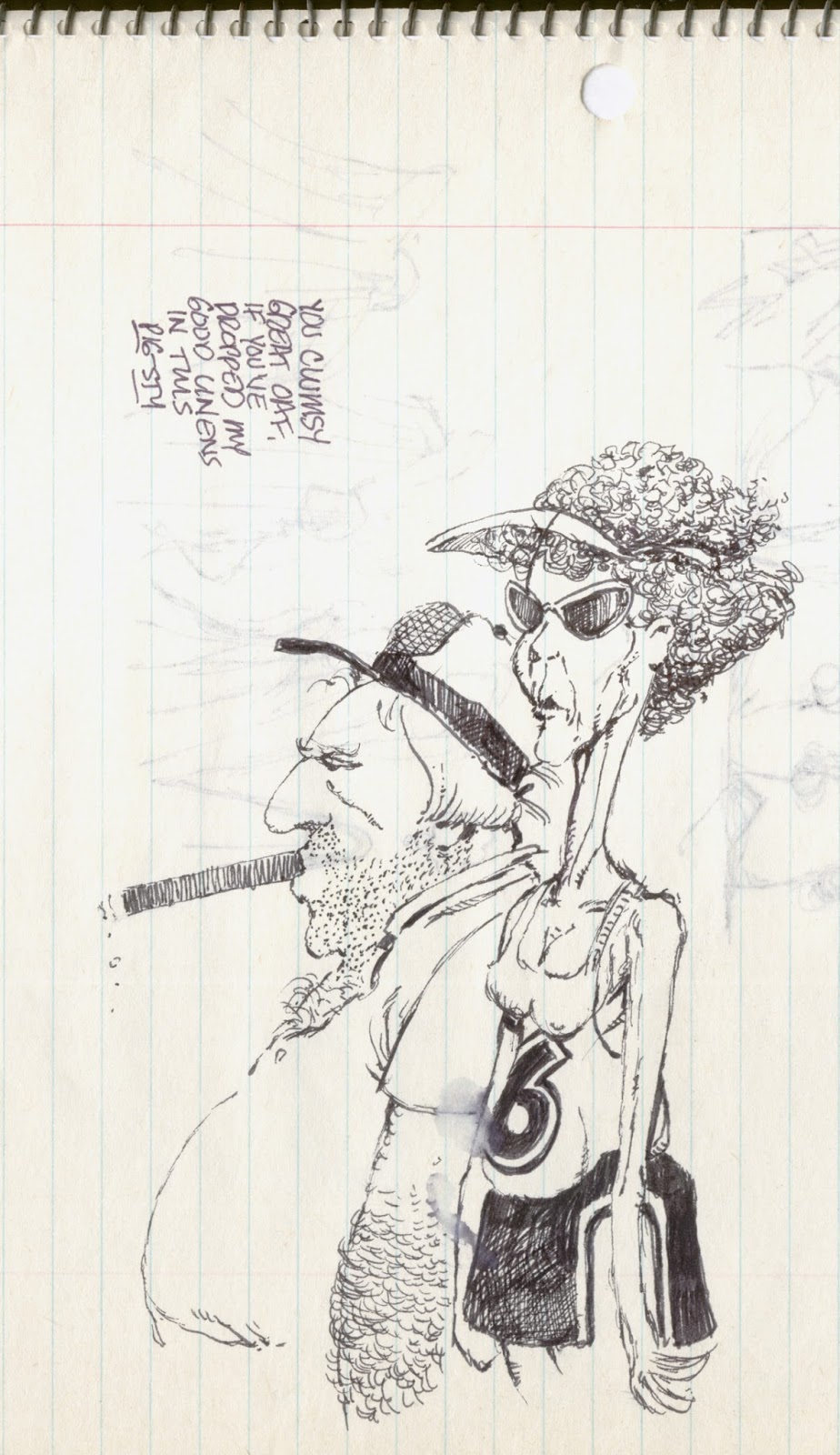
This week - some pages from Dave's notebook #5, which covers issues #70 to 79, so this notebook spans approximately late 1984 to middle of 1985. These pages are some of the sketches of friends and random people.

The first page, page 37, has been rotated 90 degrees as you can see by the spine of the notebook along the top of the page. I'm guessing they're tourists. The text? "You clumsy great oaf. If you've dropped my good lines in this pig-sty".

Notebook #5, page 37
My mom had that same haircut in the early 1990s. Luckily she never dressed like that.

The next sketch is of Miss Judith Bradford. She graces page 62 along with a thumbnail sketch of the cover of issue #76.

Notebook #5, page 62
Elaine is the center of page 66 where Dave signs it with his Bill Sienkiewicz signature:

Notebook #5, page 66

Restoration Bulletin: Help Ordering Church & State I?

Sean Michael Robinson:


Greetings everyone!

It's come to our attention that some of you have been having difficulty ordering Church & State I from your local comics retailer. 

It seems that the problem has to do with how the book is simultaneously a new listing (for the restored version) and an old, backordered listing (as the book's ISBN number hasn't changed).

Don't despair! You should still be able to receive the restored and revamped Church & State I, alias "the slickest Cerebus volume ever to exist" from your local Diamond retailer. Simply contact said retailer with the following information--


Church & State I Restored edition
STAR00271 (or AUG150927)
Order MAY need to be placed as a "back order" due to the way it's been listed in the system

If you're still getting a "no" from your local retailer, there's still another option. Long-time Cerebus fan Menachem Luchins runs the fantastic Cerebus-friendly comic store Escape Pod Comics, located in Huntington Village, NY. He has placed a very large Church & State I order and will happily take on-line orders for the book. To order your copy of C & S I online, contact Escape Pod Comics at EscapePodComics at gmail dot com. Menachem will give you the details from there.

And while you're at it, you could also purchase either of the other two restored volumes, or a copy of CANO or CANT portfolios.

Thank you very much to those who brought this to our attention, and for your patience!

Church & State I: A Pox On Dotville


Sean Michael Robinson:


Howdy everyone!

This will be a brief one, as I'm still recovering from last week's marathon work session to finish the newly restored Church & State I. Rest assured, plans are proceeding for Church & State II as I write this, and we should have a schedule for that book firmed up by a week from now. I'll be using the next few weeks of posts to demonstrate the work we did on the book and give you an idea of how things turned out.

In the meanwhile, this would be a great time to pay a visit to your local comic store and place an order for Church & State I! 

I thought this week I'd give you all a peek into how I dealt with one of the most challenging and aggravating problems facing C&S I. Issues 66, 67, and 70-73 all seem to have been photographed with a poorly calibrated stat camera, causing all manner of grit and pencil schmutz to be picked up in the photography along with the ink itself. In the pages where we had access to the original art, this wasn't a problem at all, but the majority of these pages were sourced from the negatives. 


The top tier of page 429, as it appears in my tenth printing of Church & State. Notice the "grimy" looking tone, which in closeup looks like areas with swollen, bulging dots. 


This is a problem where I probably should have just accepted this is how it is. This is how the pages were photographed, and short of retoning all the pages there was nothing to do about it, so how about I just relax and accept it?

Fortunately for my neurotic nature, I didn't have to accept it the way it was-- there was a solution available to me.

Here's a screenshot of a scan of the original negative. As you can see, although there's no dot gain unlike the printed example above, the problem is still there.


So I open up the Levels command and take a look.


By moving the midpoint very far to the left, and moving the black point up just a bit, we've now driven a visible wedge between the noise (non-desireable elements) and the signal (the actual ink on paper.) This is enough to then use sharpening that targets only the signal, and then use further levels adjustments to "knock out" the remainder of the noise.

Of course, it also leaves the rest of the page overexposed, too light. Look at how far away those halftone dots are from each other! Surely there would be a way to return the page to its original value?

There was indeed ... but I'm afraid that'll have to wait for another day.


Perfect? No, but it's a big improvement, and short of scans of the original art being sent to us, it's the best way forward I've found yet for these problem pages.

Of course, now that I've mostly solved it, this is a problem that disappears for a good decade or so of the book. Flipping forward, I think it affects a good 60 page chunk of Minds, and then that might be it for the remainder of the series. I'd like to think there was a purpose to it anyway, though, even if it only affects a hundred or two hundred pages or so total, even if only to indulge my need for constant improvement.

Next week-- more Mara! Less me!! Less tech talk!!!


Monday, 17 August 2015

Sand Hills Creek

Cerebus Vol 14: Form & Void
Art by Dave Sim & Gerhard
DAVE SIM:
(Cerebus Yahoo Group, May 2004)
I think Cerebus missed the point in a lot of ways about the nature of Sand Hills Creek (local mythology holds that Kitchener was once called Sand Hills, which Rych Mills, a local historian has pretty definitely disproved). The place I pictured was closer to the size of Gananoque than any incarnation of Kitchener I remember, but there are similarities: one being that people who leave tend to come back no matter how much they didn't like the place and couldn't wait to get out. That's always the side I knew. Someone would move away from Kitchener and then I'd see them back at Peter's Place a year later. The side I never thought of (always being on this side of it) was that there was never a big Hey, Welcome Home. Just a "I thought you moved to Vancouver?". So, what I'm saying is I think Cerebus was expecting more than he would've gotten even if he had come home before his father died. His father wouldn't have welcomed him back and neither would anyone else. There are Sand Hills people who stay and Sand Hills people who go. Cerebus went. It put him "out of tune" with Sand Hills Creek.

(via Cerebus Wiki)

Sunday, 16 August 2015

Covering Cerebus

MARGARET LISS:
The fanzine Cerebus The Newsletter was originally published by Fred Patten and then by Aardvark-Vanaheim from January 1981 to October 1985 and ran for 13 issues. After asking Fred Patten and Dave Sim if I could use the name of the previous fanzine, Jeff Tundis and I started anew in 2009 with issue #14. I published issues #14 through 21, which was released in November 2011. Below is an article that I wrote for the Cerebus The Newsletter - albeit the article below has additional information and pictures. If you would like to purchase back issues, some of them are still in print and can be found at the Friends of Cerebus website.

It was a cover that drew me into the series. The lush green forest surrounding this little girl all alone on a horse in a playground, it was beautiful. Sure I had heard a couple good reviews of it, but I was still a bit intimidated by not only the voluminous history of the book, but by not knowing where to jump on and start reading. The cover also told me that it was the first in a new chapter of the book. Perfect, a starting point. I picked it up and started reading.


That was issue #114 of Cerebus. With 300 issues, the covers have been as varied as pictures of “real life” landscapes to a black background with white letters to painted pictures of the series characters.

Up until issue 39 every cover had Cerebus on it.  That issue had the character that appeared on the second greatest amount of issues: Cockroach. However, in the count of cover appearances it wasn’t close between the two. Being the title character, Cerebus owned it: 164 covers compared to the Cockroach’s 18 covers. Except during Jaka’s Story wherein Jaka was on ten covers while Cerebus was only one two.

There were a total of 39 different individuals on the covers, including the one and only cover appearance of one of the two artists: Gerhard, whose picture appeared on the cover of issue #165.

Click on the above graph for a larger version
Gerhard started working on the series with issue #65, which coincidently was the first issue where the cover was text only: “Anything Done For The First Time Unleashes A Demon”.  When asked, Gerhard stated that the text only cover was Dave’s idea, as Dave didn’t want any hint of what was inside. Also Gerhard thought that since he “had been struggling so much with trying to do a good job, that there just wasn’t any time left to do a full colour cover.”  The only other cover that was only text was issue #110: “Marvel and Decease”.  Issue 65 was white text on a black background while #110 was almost a direct opposite: blue text on a white background.


Before Gerhard started there were no covers that were purely landscapes and there was one cover that was mainly a landscape, issue #61’s silhouetted Regency Hotel, which actually mostly black with white text and a small portion of it was the Regency and up along the top silhouetted in black we can see Cerebus and Weisshaupt struggling against the wind. However, with Gerhard on board there were 25 “landscape only” covers from the sunset in Iest cover of issue #141 to Oscar's room of issue #121 to the Tavern at the Wall of T’si’s bartender house and its window reflection of issue #217.

Those don’t include the 34 issues of Going Home which had the picture covers.  In fact, the two phone books that comprise Going Home: Going Home and Form & Void, were the only two phonebooks to not have any characters, including Cerebus, on the front cover.

Not only were the cover pictures themselves varied, the cover composition changed over time. For example, issue #114 was the first cover to have the over-arching storyline title on it. Every issue after it contained the storyline’s title on it with the exception of four issues of Rick’s Story.  During Rick’s Story the storyline title was incorporated into a tavern sign until issue 228 when the picture on the cover was put into the tavern sign and the storyline title moves out of the tavern sign and onto the cover.


Issue 228 coincidently was the issue wherein Rick put the binding spell on Cerebus so he couldn’t leave the tavern. With each subsequent issue, as Cerebus first talks with Dave and then finally leaves the tavern with Jaka, the storyline title became larger and larger so that by issue #231 the only visible part of it was the R from Rick’s Story. 

From the first issue to issue 86 there was a banner along the top of the cover that stated “Aardvark-Vanaheim Presents” with the Cerebus logo right below it. Issue 87 through issue 99, with the exception of issue 89, the banner stated “Aardvark-Vanaheim”. With issue 100, the banner was removed from the cover all together. 

The Cerebus logo used over the years has also changed, from issue # 1 to issue 49:

Issues #51 – 100:

And the logo used on the Cerebus phonebook and on issue 101, both released in August 1987. The logo continued on as the logo for the series until its completion with issue #300:


Over the twenty six years of publication, the Cerebus covers have changed in a multitude of ways. From the content of what was on them, how it was present to the logos that graced them, Dave Sim and Gerhard have created in the 299 covers of Cerebus works of art that, in my opinion, should have a book all their own. 

Margaret notes: Since I wrote this back in 2009, IDW Publishing will be publishing a book of Cerebus covers that we've seen Dave working on via his weekly updates. I'm pretty excited to see this book - not just for all the amazing covers, but the commentary and other extras from Dave.

Saturday, 15 August 2015

Dave Sim: The Comics Journal #100 Interview

The following interview originally appeared in The Comics Journal #100 in July 1985. Dave Sim would have been 29 years old and Cerebus #76 would have just hit the stands.

The Comics Journal #100 (July 1985)
Cover by Jaime Hernandez

As Cerebus The Aardvark embarks on a new extended storyline, interviewer Heidi MacDonald catches His Holiness's mentor Dave Sim. Sim, last interviewed in Journal #82-83, talks about the future wayfaring aardvark (both immediate and long term), and discusses the internal shake-up at Aardvark-Vanaheim. At this crucial point in Cerebus' evolving storyline, Sim's hints and ideas may prove quite helpful in the coming months.

HEIDI MacDONALD:
I don't want to get too snoopy here, but there have been changes in your personal life recently. How will those affect Aardvark-Vanaheim and CEREBUS. Or will they?

DAVE SIM:
Gee, I don't really know. Aside from allowing me to make CEREBUS the focus now, I can't see any real changes yet. You know, it hasn't really gone in to effect yet, I think once April comes and CEREBUS is the only book coming out from Aardvark-Vanaheim, it'll probably feel a little more real then. Certainly, it leaves me a lot more latitude to do what I want to do. I really don't have to consult with anybody. I'm surrounded by yes-men now.

[Laughter]

If I have an idea and tell them what it is, they say, "Wow! That's great Dave!" Oh, that's not true. I just made that up. You know, it's very typical of Deni that so many of her Notes From The Publisher dealt with the weather. Living in Canada was like a 15-year prison sentence for her. She's the only person I know who orders extra blankets from housekeeping in California hotels in July. I think she's probably very happy right now. I hope so.

In some of your previous interviews you've spoken about how an artist shouldn't have to worry about running the business end of things.

Right.

So do you foresee that as a problem, or...

Not really. Karen McKiel is staying on to handle all the business side of it, and she's awfully efficient, especially with the reduced workload. Right now, a lot of her job entails getting orders from distributors, sending out invoices and whatnot, and we will be down to, basically, just soliciting for CEREBUS JAM and CEREBUS. So, the company runs basically the same way that it did with Deni, where as long as everything runs as it's supposed to, I really don't have that much to do with the day-to-day operations, but if something comes up, somebody wants to change the rules, or convention invitations or whatever, then it's just a matter of putting in that half-hour, 40 minutes a day, going over what's changed from yesterday.

In other words, you're still free to be up in your ivory tower.

[Laughter] That your phrasing and not mine. But essentially, it's true that it's been bought for me, with the sweat of my brow, the luxury to not really be concerned about a great deal of input, the matter of me figuring out what I want to do and then carrying on with it. And, certainly, I think any creative person would view that as an enormous luxury. An enormous luxury and a great responsibility. I'm trying to be true to what I started. I'm trying to maintain the quality that I figure the book has had. That's an on-going responsibility, but there is, I think, more of an urge on my part to try and break ground on top of it.

You're still essentially self-publishing, then.

Yeah. I think some of the people who are doing newave comics and whatnot might find that not technically accurate, and I don't go down to the quick-printer and print them up and fold them myself and staple them, but, yeah, it still qualifies as self-publishing.

How do you see the state of the so-called alternative publishers?

I always know when there's been a major meeting of distributors, publishers, or retailers. For the next week I get phone calls from people who want Aardvark-Vanaheim to help finance crackpot schemes to quadruple everyone's circulation. I look at it this way. If a comic shop buys 30 copies of CEREBUS a month and sells 25, no amount of promotion is going to get him to buy 50 copies. If it does, the owner is an incredibly stupid businessman. Most people in comics don't understand money or business. The shop owners have to learn or die, as do the distributors. It isn't necessary, however, for fans or creative people. It makes for interesting schisms when you watch the four groups interact. For good or ill I think we've moved into a new era in alternative publishing. I think we'll see a further decline in the fortunes of the "mainstream" alternatives as Marvel increases its stranglehold on the super-hero market. That's not to say that I think it's impossible to turn a profit on alternative super-hero comics, it's just that I wouldn't bet the mortgage on them surviving the next decade.

Most of the comic-book companies have seen the writing on the wall. The publishers now recognise that there are artists who can sell 200,000 books and there are artists and writers who can't. As a consequence and in order to maintain their preeminence, they a) relentlessly remind the reader that there is no such thing as a bad character only bad handling of the character; b) muck around with creative work they don't understand so they can feel part of the "team"; and c) make arbitrary decisions, "corrections", and adjustments to justify what they get paid to muck about about with creative work. Most artists and writers who jump from book to book aren't moving on to new challenges so much as fleeing editorial tyranny. I'm basing this opinion on conversations with friends in the business, not press releases. There's a very simple reason I can continue to produce CEREBUS every month until March 2004. I own it. If I were just an employee, no matter how well paid, I would probably be playing musical titles at Marvel right now.

You've often said that it's the long view that you really keep uppermost in your mind. Now, let's get real here, Dave.

Okay.

How firmly do you really have the entire story in mind?

Basically, I have fragments of stories. Like a lot of what led to me putting Cerebus back in the hotel and moving him towards being Pope was that there were all these elements to the HIGH SOCIETY storyline that sort of got passed over. It's actually difficult to describe. It's not like they got passed over, it's more like, they didn't fit. Issue #50 came up, and there wasn't really any place I could put these things, but they were story points that I thought were part of HIGH SOCIETY. And the same things happen now. There are storylines that I will start to develop just in an issue. Again, it's difficult to describe, elements of all the goings-on that I've had in mind for the last six years that are still not even in the book. It's just touching on it in this page without calling any undue attention to it. It's very odd, because I know where it fits and I know that just by having somebody say this to somebody else, that that implies this has to come up again later on. Largely, that's the way I've done it. I know the touchstone points, or the key points to this storyline that are coming up, and then it's a matter of fleshing out what's there and hooking it up as it becomes part of it. I don't know if that really explains it.

Well, I don't know, it sounds like you have small pieces than one large picture.

Well, in a way I suppose that. In another way it's all a big picture. There's very little that I put the book now that doesn't tie-in in some way. It just doesn't need to right off the bat. A lot of the problem is that if you don't know why I put that in there, it becomes very difficult to see it as part of a coherent whole. I think that the lesson of HIGH SOCIETY is that certainly a great deal of it got tied up in the end, but that is very suspect.

This is obviously a very large commitment in your life to CEREBUS.

Right.

Do you ever wake up and say, "Get out of here, Aardvark!" Do you want to say that?

No I really don't. I understand the instinct, I suppose, because so many people in the business have it, of, "Well, Jesus, it's been fun for 18 months, now it's time to go on to something else." But I was having dinner with a number of people from DC and Marv Wolfman was there. And a couple of the guys were saying the same thing you're saying, like, "Get real, Dave! Are you really in this for 300 issues?" And I turned to Marv, and I said, having done 70 issues of TOMB OF DRACULA, did you not find that there was a quality to doing that that just doesn't exist with (however interesting a project becomes) one that only takes 8 months or 9 months of your time? And he waxed quite poetic in answer, saying, very much so. And, as you know, the characters begin to build the world, and you're in some ways documenting, in other ways making up, it's difficult to tell which is which, sometimes. There's really nothing that parallels it, there's really no way that I would be able to say, oh, well, now I'm going to go draw a painting and become a real artist. Or now I'll do animation, now I'll do this, now I'll do that. It's also because the fans are paying for my livelihood. I can't really get away with saying, well, you know, let's just give it a rest for a few months, because they're just readers. I think Garry Trudeau can do that because a lot of the DOONESBURY readers are DOONESBURY readers. There's no question that most of the people who are reading CEREBUS and providing me with a livelihood are fans. And, you know, this is what they've been screaming for all along. Every fan gets very upset when they get addicted to a title like Frank Miller's DAREDEVIL or Byrne and Austin and Claremont doing the X-MEN, and it's almost like you don't want to like it too much, because these guys are going to leave and go off and do something else. So basically, it is a large commitment, but, on my part, I see it as, nobody else is doing it, so I'm going to do it.

Then you do enjoy it?

Oh, yeah. Just the satisfaction of sitting here and staring over 70 issue of CEREBUS in a stack. You know, maybe I haven't accomplished too much bloody else in the last 7 years, but at least I've got a stack of comic books that I made. That's a little facetious; and it's also the thing of, you know, it's not all wide-eyed idealism either, there's the fact that if a comic book gets to #300, it achieves a certain status. Very few comic books have gone to 300 issues, where it was a coherent 300 issues. Now, SUPERMAN #1 to #300 is not a 300-issue story. You can read it, and watch it evolve and change, but basically, you're doing a merchandising package for a character. Whereas in CEREBUS, it's my intention to do a graphic novel, and if you look at how many words there are in the average novel, I figure it's going to take 300 issues to do something that can be called a novel. You know, there's enough content there, there's enough whatever there that, if there's enough pictures and words together, we're not going to call it a comic book, we're going to call it a graphic novel. Or call it Fred. That's what I want to do.

This will be called CEREBUS I guess.

Yeah, yeah.

I think that name has been decided upon. Here's a kind of metaphysical question for you.

Oh, good. I love those.

Do you have metaphysical thoughts about CEREBUS?

No, we're just good friends.

It seems to me that you're really playing with objectivity and subjectivity in the book.

Yeah.

It seems like it's very hard to find any objective truth in it. Is there any objective truth in CEREBUS?

Well, that's where you've got to be careful. The most common mistake made by fans trying to understand the storyline is mistaking implication for inference. But then, it's the most common mistake people make in life too, so what the hell. It does become a problem or a concern that there are things I figure I do know about the world, but I wish somebody on the stage would talk about it. But I don't feel a whole lot of objective truth in real life. You ask Ronald Reagan to describe Washington to you, in an objective way, he can do his best, and you can ask Tip O'Neill, and you can ask Jack Anderson, and you can ask somebody who's living in a slum in Washington, and how much is each one telling you the objective truth? They perceive objective truth, but they're not objective.

Okay.

[Laughter]


For instance, the entire situation with whose side Weishaupt is on. I mean, is he for the Cirinists? Is Astoria for the Cirinists? That entire thing has kind of been thrown for a loop.

Yeah. Well, it's going to continue to be that way, largely because alliances get shifted, depending on who's doing what. And it may be in Astoria's best interests to create the impression that maybe she and Lord Julius are still operating together. That doesn't necessarily mean that they aren't either. So, there's a lot of marriages and alliances of contrivance in the book. Which is, a lot of the problems I have with bringing that kind of thing out is that I can sit down and do a 20-page story that brings you a great deal more information, per se, than there has been in the book, but then I get protests from all the people who want it funny. It's a balancing act to know, okay, this is where we're moving for plot. Now in order to get the step, point A to point B, can we come up with a funny B, if the funny B is better than the serious B, which is the nature of the book, but if you can't find a funny B, then settle for a serious B, and hope you can find a funny B after that.

Have you ever thought of just a simple gazetteer of some of the basic facts of the world of Cerebus, like...

Yeah, I know. I hear you talking. [Laughter] I know a lot of people want that. They want that and they want a basic, flat out history of what happened so many years ago. That would be difficult in that, okay, Bran Mak Muffin. He is right. He's right in what he's saying. Things have gone wrong, because he's not as right as he should be. But if you were to try and find his truth, written down somewhere as a history of the continent, it wouldn't be there. Let's take John F. Kennedy as an example and say, okay, the perception now is this would be a liberal person, or a person with great liberal tendencies. And then, there is sort of a backlash for the last 4 or 5 years, saying this is hogwash, that he was a basic fiscal conservative, and certainly not a rabble-rouser. And which of those is actually the truth. Well, read the book, THE KENNEDY IMPRISONMENT, and there's a very reasoned discussion explaining why not very much got accomplished at all. But then you can read something by Arthur Schlesinger Jr., who's very literate and certainly very enthusiastic about the subject, and get completely carries away with that. You can say, well, yeah, okay, there was something to that. If I were to try and put that kind of information in the book, and I do from time to time, I'm doing it to a degree, but there's always a caveat there, don't take this too seriously.

Yeah, for instance, I don't know the difference between a Cirinist and a Kevilist, okay?

Right.

Does anyone?

I do. [Laughter]

I mean, how important is knowing that to the enjoyment of the strip? Or maybe that's for me to guess?

It's not critical, see, right now, you're getting the Feldwar Valley prejudice in the way of the information going out. Cerebus will go over to Upper Felda, which would be probably a good deal more important than the difference than the difference between the Cirinists' and the Kevilists' philosophy of life. You don't have to know the difference, but there's a certain -- especially in the end, because it's so insulated, with Lower Felda really hardly even under consideration by the other side -- that, it doesn't figure into it that much. It actually does, there's more activity, between the Cirinists and the Kevilists than anybody really acknowledges, just because they don't like to make it a rumour and spread it. I'm not helping you at all, am I?

No, you're not [laughter]. But then, do you want to? I don't know, it's so... I mean, let's face it, the funny stuff you can enjoy whether you don't know a Kevilist from a hole in the ground.

Right.

Yeah, so obviously, you are working on all the different levels, which is what you intend, I suppose.

Yeah, well, it's doing a 300-issue comic book, I mean, if you're doing that 6-issue book, a CLOAK & DAGGER mini-series or whatever, you're obviously doing one thing. If you're talking about doing a 300-issue storyline, you've got to have a number of major surprises, and it also allows you the luxury to really sneak up on people, which is something that I really guard very jealously. And I understand when people say, the last three issues have been dull, or whatever complain, nothing's happened, but, to me, it's a matter of contrast. If nothing happens for three issues, then you know that in the fourth issue will be a major revelation, it had that much more impact. Like, I had to lull them into sleep from time to time, just so I can wake them up with a bang and get them all excited.

Right. I think the constant complaint that non-CEREBUS fans say is, they think, come on, guys, this is boring.

Yes, well, it is. There's no question that reading a single issue of CEREBUS is not likely to convince someone to buy the book regularly. But I figure let someone read 10 issues in a row and I might as well be pushing heroin.

At a specific level, you know, if you read Dostoevsky and you're looking for PORTNOY'S COMPLAINT or something like that, yeah, you're going to be a little let down because not a great deal happens. But that doesn't mean I going to stop doing it, because, when people find this book, if they're absolutely shell-shocked, I basically appeal to people like myself, who went through reading comics and got shell-shocked. The universe blowing up. Big guys eating planets. Cosmic rays, dead guys coming back. You know, all this mayhem and murder. CEREBUS is quiet because of the contrast. I think it's a sign that it works on that level that among the staunchest readership I've got are comic-shop owners. Because by the time you've run a comic shop for 5 years, you know, when you first got into it, you usually woundup reading comic books all day. A lot of them don't read comic books, or they get very intellectual, they get down to five or six they really care about what's going to happen from issue to issue.

I think you very consciously work with the contrast that you mentioned. I notice that you even do that within the story itself. You'll have a very static set-up, looking at Stormy Weather here -

Right.

You have this very static set-up with Cerebus in bed, and suddenly Sophia's mother comes in, and is a bursting figure.

Yeah. See is Sophia and Cerebus have been having a major, screaming argument or something, they're throwing their arms around, that wouldn't work, because that wouldn't have any impact. It's the same with trying to plan those so that they occur on odd-numbered pages, so that you don't have the situation of somebody flipping it open and looking at the joke on the last panel, and then going back and filling in the story. I get frustrated with that, but I realise a lot of people do it. I'll see people flipping through an issue, the new issue that they have seen when I'm at a convention or whatever, and then they'll hit the second-last page, and start laughing because they saw what was there. Makes me feel a little cheated, because they don't start at step one, and go through the motions.

In other words, you would never have done First Impressions as a two-page spread.

No! No, because the eye just would have naturally to the -- well, we'll just leave that alone.


Yeah, right. Okay. I just want to clear this up, that you mentioned in a letter column that Henrot Gutsch (Gesundheit) is based on or inspired by some other mother-in-law, or...?

It's the grandmother character in the GILES cartoon.

Where does that appear?

It's in the DAILY MIRROR. It's one of the principal strips in Canada. They put out a book collection of GILES cartoons. They're just one-panel cartoons, but its this English family, it's been running for, God, like 25 or 40 years. Maybe even longer than that. And one of the best characters in the strip is the grandmother character. And when I was trying to think of a mother-in-law for Cerebus, it had to be the most difficult, grotesque, belligerent, obnoxious, self-centered individual I could think of, and she kept popping into my mind. So, well, what the hell, I guess that's Cerebus' mother-in-law.

Another change in CEREBUS is that you now have Gerhard assisting you. Why did you decide you needed an assistant?

Well, we worked on the EPIC story, and that was basically just, "let's see if Gerhard can actually do it." I'd seen his work and it was quite good, but I had no idea if he could handle deadline pressure, so we tried with the EPIC story and it worked very well. I don't know, I think it was largely a disinterest in background and an increasing interest in people. Gesture, composition, layout. I would try to do backgrounds, but my heart really wasn't into it. At the same time, I could see that there was a need for some background at some time, particularly in this storyline, because there's a lot that actually happens in the background. You know, it's like I know what that's doing there, and why that is what they did.

How do you two work?

Well, he draws the backgrounds, I draw the characters on top. I wanted to say that you can credit Gerhard with the resurgence of humour in CEREBUS. The guy loves to laugh and I love to make him laugh. I couldn't get the baby-throwing pages fast enough to show him. Sometimes when I can't pencil fast enough, I act it out for him. It's not a bad job doing Groucho Marx walk in and recite the next two pages of dialogue from #71.

There's this one panel here that has this enormous building and just one little hand coming out the trap door at the top. Did you really draw the hand?

[Laughter] Yeah, yeah, I really drew the hand.

Before or after the building?

Before, I believe. It might have been after. But that's one of those things where, I suppose you could call it cheating, but this story, the storyline has a lot of establishing shots. Just because I'm trying to establish more than location. Over the next 2 or 3 issues you'll be seeing that the mountain that the upper city's on is actually a character in the book. Probably as much of a character as anybody else. I've got a few surprises coming up.

How do you feel about finally getting into the PRICE GUIDE?

Now, that CEREBUS is in the PRICE GUIDE, there's a whole new group that likes me a lot. Diana Schutz's move from California to New York was paid for by selling her CEREBUS collection. (Yes, Diana, I know, only the ones that are reprinted in SWORDS.) I think that's neat. I look on the first issue of CEREBUS as 2,000 shares of stock in Aardvark-Vanaheim. From a dollar a share in 1977 to 2,000 a share in 1985 isn't bad. It's not Xerox, but it's not bad. Actually, it didn't bother me that CEREBUS wasn't in the GUIDE. What bothered me was the History Of Comics: 1933 To The Present in the front of GUIDE. The big events for 1977 were the SPIDER-MAN and HOWARD THE DUCK newspaper strips, and in 1981 Pacific Comics is credited with inventing the direct-sales market.

So how does it feel to be superstar Dave Sim?

I can go to a convention and be famous, but if I walk into a coffee-shop next to the hotel, I'm not. You can tell the professionals who prefer the convention to the coffee-shop because the fans call them assholes behind their backs. I refuse to sit on panels at conventions now. If thoughts were dynamite, the average amount of though expressed on the average panel wouldn't be enough to blow your nose. But there is the thing I like best about conventions which is that at 7:00 when they close there's at least 100 grown-ups looking for some fun in a strange city. We usually find each other. I've had some of my most memorable Friday and Saturday evenings at conventions. On the other hand, I see the whole comics environment, books, shops, dealers, artists, fans, as one of the purest and most enduring repositories of FDR's New Deal and JFK's New Frontier. It takes the occasional drunken swing in the direction of Woodstock but there aren't enough party animals to maintain it.

Let's see. Any final thoughts on CEREBUS you want to...?

No, I don't think I'll be ready for final thoughts on CEREBUS for another 18 years yet.

Okay, then...

Final thoughts for right now... I generally have a hundred voices raging in my head at once. Rather like this interview if all the words overlapped. Once, in 1979, I thought, "I have all the pieces, haven't I? I just have to fit them together." All the voices immediately ceased. It was an interesting moment. (When I read Windsor-Smith's interview in ARIEL where he described seeing a red light jump out of someone's head and bounce around the room, I felt a lot better. Up until them I thought I was crazy.)

I don't know if this is an appropriate forum to rebut Jim Friel's comments about SWORDS OF CEREBUS in a recent JOURNAL issue, but I just want to put all the distributors and shop owners' minds at rest: SWORDS OF CEREBUS is no longer on a tri-yearly schedule. When everyone at conventions starts begging me for the next volume, I start producing it. In the case of Volume 6, I didn't start on it until most if not all of the issues between #21 and #25 were totally completely and irrevocably unavailable in any significant quantity. The same will be true for Volume 7. It wouldn't go into production until issues #26 through #29 are completely unavailable. The comic shops are the life's blood of Aardvark-Vanaheim and I intend to cooperate with them every step of the way to issue #300.

As far as CEREBUS goes, I'm pleased to have a toehold that's getting more secure all the time, especially for alternative comics, I think. As satisfying as that is, ego-wise, I'm probably more flattered that there's security to it now, that whenever Marvel decides to glut the market again, there is a different place for CEREBUS.

You think that your niche is secure?

Oh, I think it is. If I announce tomorrow that everyone's screwing me around, so I'm not going to do the book any more, you're liable to see people have heart attacks. So you'll never know how it turns out.

"Dave Sim is leaving CEREBUS." Well, there'll be a lot of blank pages.

Well, I may do a special vacation issue sometime, where it'll just say Special Vacation Issue on the cover, with blank pages all the way through. My vacation. But I think there's a possibility -- that before #300, I have to take a rest at some point. I don't think I can do what Garry Trudeau did. At least, I would hope not. But, aside from that, Gerhard and I are amazed every month that it gets done. But it gets done. I congratulate myself and start all over again.

You don't feel that you need the vacation right now, but you know you will need one someday.

Oh, I probably do need the vacation right now. I'm pretty thickheaded about those kind of things. Gene Day always used to have the theory that when things are going wrong in your life, you're all fucked up about something, the only thing to do is work. It's pretty helpful.

Oh, one last question. Do you have a name for the new storyline yet?

Yes. It's probably going to be called CHURCH & STATE. It's that pretentious.

Well, it's short.

It is short, but it's pretentious.

Well, I guess we can be pretentious about being pretentious or something.

Okay, that sounds good.

Oh, this is the special 100th issue gala. Do you have any special comments on the occasion of THE COMICS JOURNAL's 100th issue?

Oh my God. [Laughter]

Okay, that's a pretty good one.

It's very nice to know that it's lasted this long. It's nice to have somebody around besides me who pisses off so many fans, month in month out.

Friday, 14 August 2015

Jeff Seiler: Dave Sim & Me

JEFF SEILER:
Eleven years ago, when Cerebus ended, Dave Sim decided to answer all of his back mail. A month or so later, he had his "Jeff Seiler Day" in which he answered multiple letters I had written over the previous year. After I received that letter, I decided to keep writing, and he kept his promise to answer every letter he received. And now, I have a foot-high stack of letters written and received over 10 years or so. I will be posting full paragraphs or pages of interesting excerpts from those letters every Saturday.

From a letter dated 13 November, 2004, from Dave to me:
Thanks for the clipping from The Dallas Morning News. Yes, that was a strange one. She just phoned out of a clear, blue sky, told me she was a Cerebus reader and she wanted to write about Cerebus coming to an end and wondered if I would do an interview. It was such an unusual request that I said, sure, fire away. I answered her questions for about forty minutes or so and then the last two questions were about my views on feminism and my religious beliefs. Which is usually a bad sign. It usually means that they're just softening you up and then they want the quote that they want for the smear piece. So I was pleasantly surprised that that wasn't the case. The quotes certainly don't sound like me, but that doesn't mean they aren't accurate. When all you're doing is pulling three sentences out of forty minutes of conversation, "out of context" is pretty much a given. I was particularly surprised that there is absolutely no reference to anti-feminism, apart from the description of parts of the book containing anti-feminist treatises. I have no idea what the motivation might've been behind the piece being done or how the editor could've authorized it -- presumably it was old news in any newspaper frame of reference -- but it was definitely a "one-off" so it didn't bear with thinking about. Yeah, the charity thing doesn't get mentioned much because it just doesn’t fit the profile of raving, lunatic misogynist. People who go insane aren't usually big contributors to charities, so that part usually just gets edited out while they're creating their version of Dave Sim. The recurrent motif is "the edge of madness", "the brink of madness", I suspect to avoid possible libel actions. I've been considering spreading the word that I have no intention of ever suing anyone for libel as a matter of principle so that all the folks who have been holding back can really let fly. It seems to comfort them.

Weekly Update #95: Compensating Gerhard


Dave Sim talks about the restoration of Church & State I (at the printers now!),
and how Gerhard was, and is still, compensated for his contribution to Cerebus.

Wednesday, 12 August 2015

Gene Day: Born On This Day 64 Years Ago

Master of Kung Fu #119 
(Marvel Comics, December 1982)
Born 13 August 1951, Died 23 September 1982

Calling Dave Sim

MARGARET LISS:
A few years ago I scanned all of Dave Sim's notebooks. He had filled 36 notebooks during the years he created the monthly Cerebus series, covering issues #20 to 300, plus the other side items -- like the Epic stories, posters and prints, convention speeches etc. A total of 3,281 notebook pages detailing his creative process. I never really got the time to study the notebooks when I had them. Just did a quick look, scanned them in and sent them back to Dave as soon as possible. So this regular column is a chance for me to look through those scans and highlight some of the more interesting pages.

A quick one this - as my Cerebus collection is packed up for the big move. This week we'll be looking at Dave's notebook #21. We've looked at it once before, back at the start of this year in "Joanne and Fred (not that Fred)". Notebook #21 covers issues #197 to 211. It started out with 200 pages, but only 138 were scanned and there were 17 blank pages, leaving 62 missing pages.

The pages I grabbed from notebook #21 were of Cerebus' call to Aardvark-Vanaheim. Not that Dave picks up the phone any more - it always goes to the answering machine as far as I know. Cerebus tries to make up in his own way, and asks Dave to put him at the Tavern at the wall of T'si.

Notebook 21, page 34

Notebook 21, page 35