Friday, 6 April 2012

Idealism

Cerebus #50 (May 1983)
Art by Dave Sim
(Click image to enlarge) 
DAVE SIM:
(from Aardvark Comment, Cerebus #53, August 1983)
I was not trying to portray idealism as heroic - quite the contrary. As much as I feel a great stirring inside when I think of Kennedy's Thousand Days or Lech Walesa and his Blows Against The Empire, neither, I suspect, has any basis in reality. Or very little. Allen Varney's assertion that most of High Society's cast was "motivated by greed and guided by relentless cynicism" strikes me as a charge levelled by (dare I say it?) a closet idealist. Of course they were! What so you suppose keeps the world going? There are people who want to set the course for world events, but there are more people who want to tear off a little piece when and where they can find it. Period. 

Astoria's motivation (which she dealt with briefly and defensively in #50 since the idealism of it conflicted with her carefully cultivated veneer of cynicism) was to get women the right to vote. To her, the way you do that is to change the election rules so that any male over a certain age can vote. If she could make that work, she would have a good chance, over a period of years to introduce limited voting for females. The unforeseen effect of this among the aristocracy (still a visible group in Iest, unlike Panlu or Beduin) was a whole-hearted endorsement. Particularly among the young members of upper classes who sensed the wheels of (no pun intended) revolution by about one hundred and eighty degrees. ("By the time I got to Woodstock we were half a million strong"). These are the Anarcho-Romantics.

Not only should everyone be able to vote, but we should persuade all our fathers to give all their money to the poor people, so they can have reflecting pools and sweet-meats and apricot brandy. Wrong-headed idealism? Probably. Naive? No question. But the fuzzy-brained improbability of it all leads Suenteus Po to write his books on the 1413 election and Cerebus' term as Prime Minister and a growing awareness that the goal of any great civilisation is (or should be) the freedom of its people from tyranny. Many readers made the mistake of thinking that the last page of #50 was intended to show Suenteus Po as a paragon of virtue - or something. Not at all. He was showing youthful rebellion in full flower. Tilting at Windmills even as his movement falls into ruins, knowing he was right and the rest of the world was wrong. He switched father-figures that was all. From his own aristocratic pater to the rabble-rousing "Power to the people" Prime Minister.
Cerebus #47 (February 1983)
Art by Dave Sim
(Click image to enlarge)

Thursday, 5 April 2012

Cerebus #50 Dedication

Cerebus #50 (May 1983)
Art by Dave Sim


DENI SIM:
(from A Note From The Publisher, Cerebus #50, May 1983)
This issue is the final chapter in Dave's 500 page graphic novel, High Society. Together, we have watched an insignificant barbarian become a powerful political figure... When the story was ended Dave discussed with me the possibility of dedicating this issue. In his own words to "Lech Walesa because of his political integrity against overwhelming odds", "the memory of John F. Kennedy and the words of his speechwriters for the idealism they invoke", "to Wendy Pini for her steadfast view that real heroes should cry real tears" and to "the memory of Gene Day for always pushing back the boundaries of graphic art."

Given enough thought, the list becomes endless. Some may call these people heroes, some may not, but choosing one person became a hopeless task.

There is one "personal hero", however that we both agree on, John Lennon, a man of peace, shot down in violence.

Wednesday, 4 April 2012

Swords Of Cerebus

Swords Of Cerebus Vol 1
(Reprinting Cerebus #1-4, January 1981)
Art by Dave Sim


DAVE SIM:
(from a letter to Mike Fullerton dated 11 June 2004, Dave Sim's Collected Letters Vol 2, 2007)
Yes, that might very well be the case that the first five volumes of Swords are superior to the first phone book in the presentation of the material. Except perhaps as regards paper stock. We use a white newsprint now which tends to hold the ink better. But I do understand your preference for the introductions interleaving the material itself. I call it the Harlan Ellison syndrome - something I noticed in reading his short story collections, that I would get impatient with the stories themselves because I was so interested in his reminiscence. Which, given the quality of the fiction, was doing the material a grave disservice. I realised kind of late that I was doing the same thing myself and chose to dump the introductions when it came time to do the Cerebus phone book [Vol 1 collecting Cerebus #1-25]. It's still our best-selling book, but I don't know if that's just because people hear about Cerebus, try to start from the beginning, read this sophomoric, badly-drawn humour and go, "Well, I don't get it" and that's the last book they buy. Or if they're in the category of really thinking this stuff is the bee's knees and they give up on the rest of it.

Tuesday, 3 April 2012

Out Now: Glamourpuss #24

Glamourpuss #24
by Dave Sim
Aardvark Vanaheim, $3.00

The Solicitation Blurb:
Things were getting pretty heated last issue with charges of homophobia, racism, and Islamophobia being thrown around in the Zootanapuss and Bunny vs. High Fashion Models smackdown leading to this 'Sudden Death' issue. Who 'buys the farm' as glamourpuss comes to the end of its fourth year? glamourpuss? Zootanapuss? Bunny? Plan Nine from Mogadishu? Junkie Haute Couture? Find out on page 10! Also, in the 'History of Photorealism' section, Stan Drake and Alex Raymond tool around Westport, Connecticut and environs in Drake's ill-fated 1956 Corvette.

Glamourpuss #24 is available to buy right now from your local comic shop
Back-issues of Glamourpuss are always available from ComiXpress.

Monday, 2 April 2012

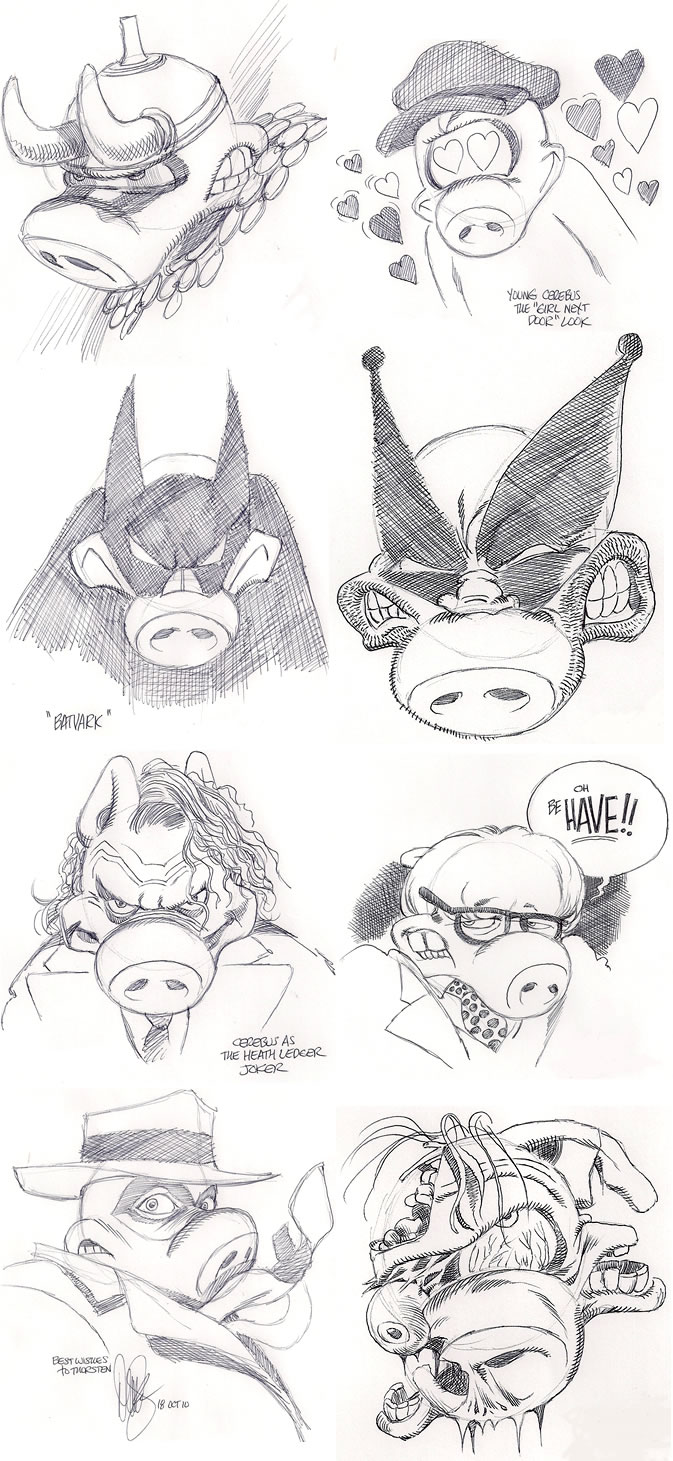
Cerebus Head Sketchapalooza

Over a hundred Cerebus head-sketches, drawn by Dave Sim between 2010 and 2011 and sold via auction at Cerebus TV, have been posted online by John Scrudder and are available to view right now at Behind The Panels.

Sunday, 1 April 2012

The Barbarian Messiah: Contents

Following on from yesterday's Q&A with Eric Hoffman, for those of you interested in the contents of the essays contained in Cerebus: The Barbarian Messiah, Eric has kindly shared with us the table of contents together with extracts from the Preface. Cerebus: The Barbarian Messiah is published by McFarland and available from Amazon.com and Amazon.co.uk.
TABLE OF CONTENTS

Preface

Introduction
Alone, Unmourned and Unloved: Dave Sim and Cerebus by Eric Hoffman

Part One: A Map of Estarcion
1. Growing Complexity or: The Cerebus Effect by Sebastien Domsch
2. Audacious Tenacity, Tenacious Audacity: Cerebus’ Grand (and Changing) Narrative Strategies by Eric Hoffman

From the preface:
The first section, A Map of Estarcion, explores the various techniques Sim utilized in fashioning Cerebus, in particular the high degree of flexibility Sim employed to allow the significant changes in theme, tone and structure, and how Sim developed this elaborate plot over the period of the twenty-six years he composed the comic book.

Part Two: Ignore It, It’s Just Another Reality
3. Stories within Cerebus by David Groenewegen
4. Aardvarkian Intertexts and True Stories by Dominick Grace
5. 'Why Certainly Dear Boy…’: Incorporating Oscar Wilde into the Aardvark’s World by Gregory J. Fink

From the preface:
The essays of the second section, Ignore It, It’s Just Another Reality, concern Sim’s use of storytellers within the larger narrative framework, and how each storyteller represents a shifting perspective that opposes any verifiable claims of truth. Use of this technique allowed Sim to transgress his own limitations, providing him with the freedom to shift the focus as he saw fit, so that, as in an extreme example, Cerebus simultaneously satirizes religion (largely characterized in the comic as outright delusion and a means of coercion and control) and elucidates Sim’s evolving religious beliefs. Similarly, Cerebus itself is a claim to truth that opposes the “story” of feminist politics and political correctness, particularly in the text interpolations dispersed throughout the comic, both internal and external to the storyline proper.

Part Three: Becoming Synonymous with Something Indescribable
6. Seeing Sound by C.W. Marshall
7. Negative Space and Guttural Noise: Gerhard's Psychological Reads by Sabin Calvert

From the preface:
The third section of this book, consists of a meticulous study of Cerebus’ visual virtuosity and technical sophistication, addressing in particular Sim’s imaginative and descriptive use of lettering.

Part Four: Mind Games
8. Testing the Limits of Genre/Gender by Dominick Grace
9. Anti-Feminist Aardvark?: Gender, Subjectivity, and Authorship by Isaac J. Mayeux
10. The Aardvark and the Beautiful Women: Male Sexuality and Gender Politics by Mario N. Castro

From the preface:
The fourth section, Mind Games, is an exploration of perhaps the most problematic, yet important, aspect of Cerebus, namely the use of gender, both as a narrative device within Cerebus proper and in Sim’s supplementary essays, which together comprise an extended critique of institutionalized feminism. The interplay between genders involves some of the best and worst of Cerebus. The introduction of feminist critique, both within the Cerebus storyline and the tangential material accompanying the primary text, compromises by a blurring of authorial intention. From the nuanced representation of gender roles and female-male relationships in Jaka’s Story, to the anti-feminist polemics of Reads, these essays address Sim’s views of gender both within the context of Cerebus’ storyline and its larger social and religious implications.

Part Five: Ye Booke of Sim
11. YHWH's Story, or, How to Laugh While Reading 'Chasing YHWH' and Still Have Enough Stamina for The Last Day by Edward M. Komara

From the preface:
The fifth and final section, Ye Booke of Sim, consists of one reader’s attempt to salvage what is generally considered Cerebus’ most unreadable section, the Chasing YHWH section of Latter Days, consisting largely of Sim’s 'Cerebexegesis' of the Book of Genesis, by offering a new way of reading the text and viewing it within the larger context of Sim and Gerhard’s work.

Appendix

An Introduction to the Cerebus 'Phonebooks' by Lenny Cooper.

Saturday, 31 March 2012

A Q&A With Eric Hoffman

Eric Hoffman is the editor of Cerebus: The Barbarian Messiah: Essays On The Epic Graphic Satire Of Dave Sim & Gerhard, a collection of critical essays focused on Cerebus, published by McFarland. Eric kindly agreed to answer a few questions about the book itself as well his motivation for undertaking such a project. This short Q&A is essentially a post-script to Eric’s in-depth interview in Following Cerebus #12 published in August 2011, which is highly recommended reading for all Cerebus fans. Our thanks to Eric for taking the time to answer these questions.
A Moment Of Cerebus:
In Following Cerebus #12 you stated, "I'm not intending to put together an anthology of criticism that’s merely a round of applause" and that Dave Sim’s attitude would be, "Respect me enough to criticise me." Could you explore that idea a little more? What is it about Cerebus that makes it worthy of a book's worth of critical essays?

Eric Hoffman:
Cerebus is such a multi-layered, complex work that I think it is possible to approach it from a multitude of perspectives. I’m not generally interested in hyperbole, yet I think the argument can be made that Cerebus is certainly among the most intelligent and challenging comics ever produced, whether or not you agree with the intelligence on display there. It certainly warrants far more attention than the vast majority of comics past and present. For instance, you could examine Cerebus on a technical level, exploring Sim's expanding comics vocabulary (and its precursors). Or you could look at the comic within an historical context, within the context of the comics industry, Sim's involvement in the direct market, self-publishing, or look at it in comparison to other comics, how Sim uses the monthly comic format to tell an extended narrative, and so on. And that’s just the tip of the iceberg. There's also Sim's views on gender and religion to consider, on love, death, politics, you name it.

How did you go about gathering contributions for the book and was it difficult finding enough material of sufficient quality? Did you have a set list of subjects you wanted to cover or was it a case of shaping the contributor’s existing ideas?

Initially the project was to be a book about Cerebus written entirely by myself, but as I had just completed about a decade's worth of researching and writing on another subject, I was not interested in dedicating as significant an amount of time and energy. I had compiled some notes on Cerebus, discussing its overall narrative structure, inspired by some comments Sim made in his Yahoo Q&A and by Douglas Wolk in his Believer essay. The essay soon became quite lengthy and at that time I thought I could do a full book on it... I began contacting potential collaborators, but, regrettably, and perhaps wisely on their parts, no one was interested in the commitment, which was significant. However, I did sense an interest there; an acknowledgment that Cerebus is a work deserving of serious critical attention and from what I could tell about the only attention it had received was from The Comics Journal and Craig Miller’s excellent Following Cerebus. The next logical step was to do a book of essays and to publish it with a legitimate scholarly press. I put out a call for papers and solicited a few... what is collected in this book represents, to my lights, the best of the material I received, the most penetrating and insightful.
Six thousand pages of comics is a lot to cover in one book of essays. Are there any areas which you wish you could have covered in your book but weren’t able to?

Of course. Any project of any length is going to end up a preliminary work and there is always room for improvement or expansion. I knew this from the start and part of the reason for doing the book is to stimulate further conversation and perhaps provoke additional critical attention to a work that I obviously think deserves, even requires, such attention. I would have liked to have at least one female contributor, to get that perspective, yet I was regrettably unable to solicit any papers from women. I don’t think Sim’s technical achievement is explored as much as it could have been, though C.W. Marshall and Sabin Calvert’s essays are enlightening explorations of that aspect of Sim's work. And it goes without saying that after you turn in a final manuscript you always think of additional things, but at some point you have to cut the strings and let the work stand on its own.

Who do you think the book will appeal to - Cerebus fans, causal readers or academic scholars?

Both, hopefully. From the outset, I intended to produce something that could satisfy both readers and scholars. What you do as an editor is decide the tone of the work and structure the essays in such a way that this tone is maintained throughout. I did not want to have needlessly esoteric essays. I think the most esoteric is Mario Castro’s reading of gender in Cerebus through the lens of French social critic Pierre Bourdieu. But even that is done in a manner that is approachable and I think easy for any reader of moderate intelligence to grasp.

Was the book an 'easy sell' to potential publishers? Did your publisher, McFarland, need much persuasion to run with the book? Do you have a sense of how they view the wider comics environment and Cerebus in particular?

Nearly all of the contributors are academics and the proposal clearly emphasized the academic nature of the work. I’m not going to say there was a feminist conspiracy to keep the work from being published, but you have to realize that most universities are liberal bastions and so come with their own agendas. Actively promoting or taking seriously the work of an artist accused of misogyny may have had some impact. Dominick Grace mentioned McFarland, of whom I was aware but had not sent a proposal. I sent them the proposal and a few weeks later received a contract. They were very eager to publish the work and excited about it.
Are you planning a second volume of essays or any other Cerebus-related projects?

Yes, I do have an idea for a book of Sim interviews. With Barbarian Messiah and my other project taking up much of my time, however, I was interested in having some assistance, so I asked Dominick Grace if he would be interested in co-editing the work. He agreed, and we’ve been putting together a collection of previously published interviews. We sent a proposal to the University of Mississippi Press, who have a great catalogue of comics artist interviews as part of their Conversations series, including Alan Moore, Howard Chaykin, Dan Clowes, Harvey Pekar, Stan Lee, Milton Caniff and Charles Schulz, among others. So knock wood, we'll get final approval and get Sim onto that list.

Did you ask Dave Sim for his approval / blessing for the book? Has he read a draft of it?

I’m using about 70 images from Cerebus in the book so Sim's approval was absolutely necessary. Fair use provisions, particularly with images, are so ill-defined as to be non-existent so it is recommended you get permissions. I’d had some difficulties with permissions on another book and Sim was a 180 degree turn from that, absolutely easy to deal with and very generous with his time and energies. I didn’t send him a copy of the manuscript as that is not generally done unless specifically requested. In this case, he didn't request to review the manuscript. I think he's very much in support of artistic freedom and this extends to critical freedoms.

When did you start reading Cerebus and at what point did you realise that you needed to go beyond just being an ‘interested fan’ and actively start a project like this?

I first started reading Cerebus in 1990 but oddly enough it was via back issues and 'phonebooks'. Jaka’s Story was well underway but being a 13 year old interested for the most part in superhero comics, Ron at Dragon’s Lair Comics in Omaha, where I lived at the time, recommended I start with Church & State. I was heavy into Swamp Thing, so he pointed me toward the issues chronicling Cerebus’ first ascension. It was pretty mind-blowing for a 13 year old. I don’t think I quite grasped the satirical edge but the visuals were something else, particularly Gerhard’s backgrounds. 

I was just then getting into independent comics, Teenage Mutant Ninja Turtles and Nexus and Grendel and so on, so it was a year of discovery for me. I did a lot of growing up reading those comics. So much growing up that I left comics behind, ironically enough, and only returned to them after about an eight-year absence. So when I came back to Cerebus I had missed the whole of Mothers & Daughters, Guys, Rick’s Story. Sim was well into Going Home at that time and I was just blown away by how far he and Gerhard had developed as artists. I didn’t quite know what to make of the Hemingway storyline but the layouts and the illustrations were just incredible. By then my tastes had matured somewhat, so I was pleased to see that Sim had matured along with me. 

As far as starting this project, really it began with reading the letters fans wrote Sim after the conclusion of Cerebus, their testimonies and Sim’s letters and interviews post-Cerebus. Sim often countered criticism by saying "How can you criticize something that isn't finished yet" and now, since the whole of Cerebus is here to be dealt with, it seemed like the right time for a serious critical review of the work. The Comics Journal had a critics roundtable just after the last issue and a few years later Wolk wrote that Believer essay but it still seemed to me that something more significant and scholarly was due.
Do you have a view on how Cerebus will be judged in, say, 50 years from now - a masterpiece, forgotten, or somewhere in-between? Was it 'of it's time' or do you think it has something to offer future generations?

Well, it's difficult to predict these things with any accuracy, but if I were to place a bet I would say that when the history of comics gets written Cerebus will be something more than a footnote. But I suspect it will be more of a curiosity than anything. A useful comparison might be any other work of comparable size and complexity, say Pound’s Cantos. How many people, beyond PhD students, sit down and read the Cantos? It gets discussed, sure, but usually as a juggernaut of modernism and as an example of how extremist political views can mar an otherwise profound artistic achievement. I think Cerebus will receive much the same treatment. That is, the majority of comics readers will continue to mention it as a kind of curiosity and as an example of a time and place in comics publishing that has largely passed (the direct market, self-published black and white comic). By and large, Cerebus will be viewed as a work that, whatever its artistic merits, and there are many, was undermined by Sim’s extremist political and religious views. The last two major critical responses, by Wolk and more recently by Tim Kreiner in The Comics Journal, have largely viewed the work within this critical framework. 

Having said that, I do believe Cerebus will retain a small but devoted coterie of fans who legitimately believe it to be among the most fascinating comics ever produced, and certainly one of the most innovative. There’s very little else out there to which it can be compared. Cerebus is very much a curiosity in this medium. It runs so counter to what most readers accept to be a 'comic book' that it somehow transcends the term. And I think that is probably upsetting to Sim, who genuinely wanted there to be more comics like his, who believed, like Harvey Pekar, that the comics form is powerful enough and flexible enough to tell any story, not simply what goes on in Metropolis or Gotham or Riverdale.
Have you been reading glamourpuss and, if so, how do you think this sits in the greater scheme of Dave Sim’s oeuvre?

In 2001, nearing the home stretch on Cerebus, when asked by The Comics Journal what he was going to do after Cerebus. Sim said that was like asking a prisoner what he was going to do after getting out of prison three years before his release date. Gerhard, from what I understand, was having stomach problems near the end. When Sim announced his 300-issue project in 1978, he could not have foreseen the implications of that decision. I think it became apparent to him around the halfway stretch. You get a sense of impending exhaustion in his interviews from '92, '93 and '94, around there. After that, it is quite evident that it became a matter of crossing off dates on the calendar. It leaves me with the mental image of the prisoner counting his days by carving notches into the wall.

That's not to say that Sim and Gerhard didn't give it their all; what is abundantly evidenced by Gerhard's increasingly baroque backgrounds and Sim's maturation as a caricaturist and letterer is that they wanted to produce an excellent product and to continue to challenge themselves and their audience.

With glamourpuss I have no doubt Sim is doing exactly what he wants to do... He said somewhere before Cerebus ended that after he finished he wanted to draw pretty women, so in that sense glamourpuss is a kind of wish fulfilment. It also gives him a chance to explore some comics artists he admires, in particular Al Williamson, Alex Raymond, Neal Adams and Stan Drake. I think glamourpuss is the culmination of Sim's fascination with realism, that is the link between the fashion magazine satire and the comics history. That's pretty much the only link from what I can see...

When the first issue came out, it was a bit shocking, but in retrospect it seems the logical successor to Cerebus. After all, Sim did some similar 'tracing' work in the 'Fruitcake Park' section of Latter Days and then in a short he did for The Comics Journal back in 2001 or 2002, as well as his brief biography of the Canadian actress Siu Tua and Judenhass. I think glamourpuss is a culmination of these efforts. 

So as odd as it is, I think in that sense glamourpuss is the logical successor to Cerebus. That being said, I think with glamourpuss Sim wrongly eschews narrative, one of his greatest artistic strengths. Lenny Cooper has said something similar to this, that this seems to be what glamourpuss is missing and why it seems so different from Cerebus. Then again, after telling a 26 year story, over six thousand pages in length, I can forgive Sim for wanting to eschew narrative in favor of something a bit more free-flowing and less deterministically rigid. 

I don’t much like the fashion magazine satire; to me, it seems mean-spirited and the humor is not all that inspired. Fashion magazines are an easy target. I do enjoy the second half of the book, if only because Sim clearly loves the artists’ work and conveys that admiration successfully. In that sense, it’s far more convincing and enjoyable. I enjoy his pen work immensely... and the slick paper format really helps define the quality of his line work. If anything glamourpuss is evidence that Sim is one of the medium's great craftsmen. His page composition is impeccable. I would like to see more hand-lettering, particularly because he is so good at it. But perhaps after Cerebus he'd had his fill of doing hand-lettering, so who knows? The latest issue (#23) features some hand-lettering (see The Sound Of A 1956 Corvette) and it's like a breath of fresh air. "He's still got it!"

And finally, which comics are you reading at the moment and/or would recommend to a Cerebus reader?

As for what I would recommend to someone who enjoys Cerebus, that’s a tough one. I’d probably point to some of the work Sim has most directly influenced, like Bone or Hepcats. Right now, I’d probably direct them to stuff like IDW’s fantastic reprints of Rip Kirby, The Heart of Juliet Jones and X-9: Secret Agent Corrigan because of glamourpuss. I’ve been reading those works and damn it, Sim is absolutely right, it’s really, really excellent stuff. In fact, most of what I’ve been reading these days is reprints, as it’s a veritable golden age out there right now: Milton Caniff’s Terry and the Pirates and Steve Canyon, Frank King’s Walt and Skeezix, Floyd Gottfredson’s Mickey Mouse strips, Carl Barks Duck stories, Walt Kelly’s Pogo, Schulz’s Peanuts, Watterson’s Calvin and Hobbes, Doug Wright’s Nipper, Frise’s Birdseye Center, the list goes on and on...

I'm a wildly unpredictable reader. I jump from subject to subject as my interests take me, so my reading habits are really all over the place. I don’t follow any current comic religiously. To a large extent, the medium has really passed me by. I’ll still read anything with Alan Moore's name on it, or Peter Bagge's, or Sim's, for example, and I really enjoy a good comics anthology - Mome is good, Kramers Ergot, or even Dark Horse Presents. That’s usually a good place to find new work. Jason Lutes’ Berlin continues to fascinate me, if only he would put the book out more regularly that once every few years. Actually, that seems to be a common problem among many of the comics artists whose work I enjoy - Joe Matt, Chester Brown, Seth (George Sprott was one of the best comics I’ve read in a long while), Chris Ware - they’re all abysmally slow but when they do come out with something it’s always fascinating. So I guess that’s a question of quality over quantity. Hell, not everybody can be Dave Sim and put out a high quality book on a monthly basis year after year.

Cerebus: The Barbarian Messiah edited by Eric Hoffman is published by McFarland and is available from Amazon.com and Amazon.co.uk. You can also visit the Cerebus: The Barbarian Messiah  Facebook page.  Following Cerebus #12 (August 2011) featuring an in-depth interview with Eric Hoffman is still available from Win-mill Productions.

The illustrations accompanying this interview were selected by Eric Hoffman. We asked Eric to select his five favourite Cerebus images, a task which Eric described as "very difficult":
Church & State Vol 1 - page 585
Reads - page 22-23
Minds - page 98
Going Home - page 321
Cerebus #146 - cover

Friday, 30 March 2012

Ditkomania: Ever-Lovin' Ayn Rand

Ditkomania: Ever-Lovin' Ayn Rand (2008)
Art by Dave Sim

BLAKE BELL:
(from Strange & Stranger: The World of Steve Ditko, Fantagraphics Books, 2008)
More than anyone, the diminutive female philosopher and writer Ayn Rand defined Ditko's professional and personal life. His adherence to Rand's philosophy, known as Objectivism, forever changed his outlook on morality, finances and his mission as a comic-book creator. By immersing himself in Rand's teachings, Ditko started down a path that, ironically, would lead him away from a life of riches and fame... Her philosophy was based on the principles of rationalism and individualism, and a belief that art should mirror one's personal beliefs. She popularised the phrase "A is A" - that man's consciousness should be devoted to perceiving reality, not inventing or creating it.

Thursday, 29 March 2012

Steve Ditko

DAVE SIM:
(from The Blog & Mail, 25 November 2006)
I finished my review of The Ditko Package and, vaguely dissatisfied, I finally broke down and called directory assistance in Washington State to see if they had a number for Robin Snyder. It's one of those things that I tend to be ambivalent about in the comic-book field particularly when you're looking at a book that's from seven years back. What are the odds that all the playing pieces are still on the same chessboard and in the same configuration? From my experience, not very good. I'm one of the few people I know where I can say that I'm still in the same geographic location I was sixteen years ago, with a phone number that predates that by probably another seven years. And, no, they didn't have a phone number for Robin Snyder on Yew St. Rd. but they did have a number for a Robin Snyder on Canterbury. Now we are into serious ambivalence. What are the odds that it's the same Robin Snyder? So I phoned and asked "Is this Robin Snyder?" "Yes it is." "The Robin Snyder that works with Steve Ditko?" and sure enough it was. My first question was out of my mouth before I could even assess whether I wanted to ask it.

"How's Steve Ditko doing?"

Robin laughed heartily and said, "He's doing GREAT!" with just that level of emphasis which was more than reassuring: communicating the sense that there are probably people in the world where it would make sense to ask about the state of their health and overall being but Steve Ditko definitely isn't one of them.

Robin didn't have much time to talk - he and his wife were getting ready for a trip to another part of the state to "visit the kids" - but I did manage to get some basic information about how RSComics is doing and where he is in his collaboration with Steve Ditko. They've done a total of FIVE Ditko Packages (the one I have is the first) and besides that they've done roughly THIRTEEN other projects in the last seven or eight years. They did have a website at one time, but Robin closed that down and now they do strictly mail order. He said probably their best selling title is the smaller 32-page Ditko Package. I asked him if he had a ballpark figure of how much it would cost to buy everything they have and he guessed somewhere around $110 US. I asked if he sold to comic-book stores and he said they did on occasion but they don't offer stores a huge discount - he said the highest they go is maybe 15 or 20% - so that tends to limit their orders from comic-book stores (which usually need at least 40 to 50% off). He laughed again and said that it's more common for a huge Ditko fan to run across one of their books somewhere and get in touch and then order, you know, EVERYTHING. Which is why the $110 ballpark figure wasn't a real challenge for him.
It's an interesting field where someone who is that much of a comic-book household name (and apart from Stan Lee and Jack Kirby I don't think there's a name in that category in the comic-book field) can still be happily producing his own work on a regular basis and just selling it direct (or, at least, relatively direct) to his legion of fans without Diamond and without the comic-book stores. Not with any animosity, just that this way of doing things suits his purposes and so he's happy to just keeping hoeing his row in his own way on his own terms.

...After I hung up, I thought, You know? Wouldn't it be nice if just once we could have one of those great comic-book outpourings of affection BEFORE one of these legends kicks the bucket or we find out he's in hospital barely clinging to life? Wouldn't it be nice if everyone for whom Steve Ditko means the world (in many cases that isn't hyperbole if you've ever met a Ditko fan - this is a guy who had his own Ditkomania fanzine devoted to him back in the 1980s, long before the Jack Kirby Collector came out) could write to him - while he's still doing GREAT - in care of Robin Snyder and tell him so? And (not to be totally pushy) maybe send along a few bucks for Ditko's latest project (whatever that might be?). I mean, if you don't think it's a good idea, don't feel obligated. But if the idea just really bangs your gong, sit down right now and send a nice letter and a few bucks to:

Steve Ditko
c/o Robin Snyder, 3745 Canterbury Ln. #81, Bellingham, WA, USA 98225-1186
or at least send him an e-mail at RSComics@aol.com
Steve Ditko is the co-creator of Spider-Man and Doctor Strange for Marvel Comics and has continued to write and draw comics for over 50 years. Much of his post-Marvel work is available via Robin Snyder at RS Comics (the Ditko Blogspot lists all the Ditko books currently in print).  Fantagraphics Books are the publishers of The Steve Ditko Archives, reprinting never-before-collected horror and science-fiction stories from his early pre-Marvel career.

You can find out more about the life of Steve Ditko in a fascinating 2007 BBC documentary (now posted on Youtube) as Jonathan Ross goes In Search Of Steve Ditko.

Wednesday, 28 March 2012

Jaka (Now)

Cerebus #265, April 2001
Art by Dave SIm & Gerhard


DAVE SIM:
(from Aardvark Comment, Cerebus #268, July 2001)
For the first time [Cerebus] was able to see Jaka precisely as she was and as she is and as she always would be: a spoiled, myopic, insensitive, self-absorbed and self-important harlot princess (quite apart from her position in the hierarchy of the city-state of Palnu). It was entirely his choice, as there things always are, but while he was passing time with a spoiled, myopic, insensitive, self-absorbed and self-important harlot princess, his father died alone and in the company of mere friends and mere neighbours. A loss of personal honour on the part of Cerebus that is almost unimaginable in an environment where such things matter (to say the least) a great deal. Not only do such things not happen "to the best of us," it is (in my experience) precisely the choices one makes in these situations which established the irrefutable line of demarcation between "the best of us" and "the rest of us". Personal honour demands that a son is there for his father (so long as one's father wants the son to be there. In the case of an estrangement chosen by the father, personal honour demands that the son stay away or until he is summoned by his father). Depending on one's standards (or lack of the same), one participates in wanton harlotry with wanton harlots. Human weakness is human weakness, after all. But to allow one's taste for pussy to intercede in the far larger and more important realm of one's relationship with and obligation to one's father is (in my view) to erode one's standards to those of a rutting barnyard beast. The lockout that Cerebus experienced just reminded him of the world of high standards that he came from and the extent to which his own standards had eroded.

Tuesday, 27 March 2012

Jaka (Then)

Cerebus #129, December 1989
Art by Dave Sim & Gerhard


DAVE SIM:
(from Note From The President, Cerebus 114, September 1988)
Someone took me to task for revising history and claiming that Jaka was not based on Deni. They were going by Deni's Note in Cerebus #6 which stated that the story-line was a wedding present to her. It was, but it was more or less a cautionary tale trying to inform her obliquely (if not opaquely) of strong emotional ties I still felt for the woman Jaka was based on - who became an exotic dancer (read stripper) shortly after Jaka first appeared. The emotions depicted in the drugged Cerebus reflected the feelings I had toward the mistress I had at the time Deni and I got married. Three menacing figures in that story were named, anagrammatically, out of Deni's last name and my mistress' last name (Loubert and Hitchens became Tchens, Trebu and Lohi). I was naive and ridiculous and the poorest imaginable husband material (still am) but my subconscious was at least able to dredge up what I considered a particularly interesting character out of a singularly unstable period of my life. The really interesting thing to me as the creator of Jaka is that even though I can trace her origins from Deni's wedding present to what I felt for Sally to the lingering allure of Lynn, she resembles these three not in the slightest (except for having Lynn's hair). I had a very clear picture of her from the very beginning. I always found her easy and enjoyable to draw.

But the most appealing quality about her is that she has led a simple, almost completely uneventful life (almost). Unlike most of the characters in the book there is no need to pick and choose among the myriad forces, incidents and relationships that shape a character. Virtually everything that makes Jaka Jaka can be covered in pretty short order, and the resultant person is pretty basic and easy-to-understand.

I admire the character far more than the other characters in the book. Cerebus is too much of a born loser; wilfully self-destructive. Astoria is too single-minded and humourless. Lord Julius is always "on"; the Roach too out of touch with anything approximating reality, even the Elf is too mind-lessly happy all the time. When I'm writing them I'm observing from a discreet distance. I'm interested, but not to the extent of wanting to have dinner with them or anything like that. Jaka on the other hand is someone I would happily spend a lot of time with. She embodies those qualities I always look for in a woman. She has a very simple way of thinking for which she is unapologetic. She's loaded with common sense and self-confidence. She is direct and has a low threshold for bull-shit. She has virtually no interest in material possessions though she has an appreciation of them. She is almost certainly on the top rung of the karmic ladder and won't be back for another life-time.

Monday, 26 March 2012

Cerebus Archive #7-12

Cerebus Archive #7-12 (April 2010 - February 2011)
Art by Dave Sim
LOGAN DeANGELIS, CEO COMIXPRESS:
(from the ComiXpress blog, 27 October 2009)
It is with great pride that I make this post. As a lifetime fan and reader of indie comics, Dave Sim's Cerebus always had a special place for me. The depth of the story, the wry wit and social commentary, the brilliant art of the book… this was the reason I read comics. As an aspiring cartoonist, I admired Dave’s championing of Creator's Rights and his groundbreaking work in Self-Publishing. This guy's day didn't end when he put down his pencil after knocking out a page; he effortlessly changed hats from creator to businessman, showing a generation of cartoonists how it could be done if you had the brains and the guts, and in many ways made the independent comic book explosion of the 80s possible.

That inspiration is a big part of what drove me to create a company in 2004 that changed the way indie comics were made. And I couldn’t be more excited that Dave Sim has brought his work to ComiXpress. Starting today, with the premier of Cerebus Archive #4, you will always be able to order every back issue of Cerebus Archive, Dave’s black & white walk down memory lane (completely devoid of rose-colored-glasses). No back issues ever go out of stock at ComiXpress, and Comic Shop Retailers are a welcome addition to this new Direct Market with a book from one of the most respected names in comics who has proven time and again how seriously he treats deadlines and release dates.

So please, join me in welcoming Dave Sim, Aardvark-Vanaheim, and of course Cerebus himself to ComiXpress. And lets all look forward to a brighter future for indie comics together.

Back issues of Cerebus Archive are always available from ComiXpress.

Sunday, 25 March 2012

The Joys Of Sailing

Cerebus #117, December 1988
Art by Gerhard

GERHARD:
(from an interview in Following Cerebus #3, February 2005)
Sailing offers a lot of challenging and interesting prospects. Just the whole concept of using the wind to propel you through the water is a fascinating and elemental experience. The only sounds are the wind in the sails and the water on the hull (unless we have the stereo playing or have Rose's sister on board). When we're on a beam reach and I have the sails trimmed just right, the boat is practically sailing herself, gliding through the calm water, surrounded by the indescribable blue of Georgian Bay, in the distance the white limestone bluffs of the Niagara Escarpment rising from the deep green trees, overhead the big, pale sky streaked with soft, white clouds - well, it just makes me glad to be alive. And at night - the stars! I've had trouble finding the Big Dipper because it's lost in all the stars you just don't see in the city. Being on the bay makes me humble, awed, and thankful. And keeps me sane (saner?).

Saturday, 24 March 2012

Lenny Henry

LENNY HENRY:
(from Lenny Henry's Blog, 9 March 2004)
I'm reading Cerebus, at the moment, we're coming up to episode 300 now and its building to the big finale. Dave Sim the writer creator of Cerebus the Aardvark, has crafted an immensely dense, challenging and at times hilarious study of a very eventful life. He started writing it in the seventies, so I should think when he's finished he'll want a good lie down.

(from Lenny Henry's Blog, 19 June 2004)
Cerebus is over! He’s finally dead and gone, and now Dave Sim can lie down after 30 years of graft, and not have to worry about meeting deadlines or being quite so obsessive. He’s finished his masterwork. Perhaps, now Dave will be able to have some fun and relax a little. 

DAVE SIM:
(from a letter to Lenny Henry dated 29 May 2004, printed in Dave Sim's Collected Letters Vol 1)
Thanks for your fax of May 25 and the congratulations on the conclusion of Cerebus. Very much appreciated, especially the "Big respect" part. I've stood next to you, you know. As big goes, you're right up there.

(from a letter to Joe Matt dated 8 April 2004, printed in Dave Sim's Collected Letters Vol 1)
A few years ago, I did a revised version of a movie script that Lenny Henry had written, basically for the experience of writing a film script in the way that I did the Animated Cerebus Portfolio - to get it out of my system if I could. Which it did in both cases. Got animation and movies out of my system. Okay, I now know what that is, now I don't have to go after a deal to do animation or to write a movie script. I could cheerfully do it again, under the same terms: give me the script and I'll write my own version of it but not on a collaborative basis. I'll just redo it and give it back and you can throw all of it out, keep some of it, keep all of it. If someone offered me money to do that - to be a script doctor - I would probably do it. Only one version, though, no meetings, no revisions. My agreement with Lenny was: if the movie gets made, I don't want any of the money or my name on the film. I just want to know what it's like to do this. Nothing ever happened with it, that I know of.

(from annotation 10 in Dave Sim's Collected Letters Vol 1)
...I was actually very impressed with what he had come up with - the script read like a really good all-ages Hollywood film and it was a great experience to see how a movie is built and how condensed the writing needs to be. But I'm a terrible collaborator, I'm afraid, and, according to Neil Gaiman - who read my version of the script at Lenny's place - I used way too many explicit directions to the actors and actresses. Complete control freak, that's me.

Lenny Henry is a Britsh comedian and actor.

Friday, 23 March 2012

Recommended: The Man by Vaughn Bodé

The Man (1967)
Art by Vaughn Bodé

DAVE SIM:
(From an interview, The Comics Journal #184, February 1996)
...Vaughn Bodé's The Man, that was an enormous influence on me looking at however many pages that is, maybe 32. Just cover, copyright page, 32 pages of story, you're out of there. That's a really effecting piece of work. It's not complicated, anybody can follow it, every time you read it you can get something else out of it.

From an interview, The Comics Journal #83, August 1983)
Vaughn Bodé's The Man, the underground that he did, I consider it a definitive piece of comic book art. I still own it and wouldn't part with it for love or money.

Vaughn Bodé's The Man is reprinted in Schizophrenia available from Fantagraphics Books.

Thursday, 22 March 2012

New Mutants #52

New Mutants #52 (Marvel, June 1987)
Art by Bill Sienkiewicz
Many thanks to Jay for posting this comment in response to yesterday's post about X-Men #160:
[The S'ym character in X-Men #160] always seemed vague (at best). While obviously the name is a poke at Dave, Sym looks NOTHING like Cerebus. He wears a vest. That's all. Even Bill Sienkiewicz, who was friendly with Dave at the time, and drew Sym in a few New Mutants issues, seems to have NOT got the memo that Sym was anything even vaguely Cerebus-esque. Only years later when he did a cover had this assertion (somehow) hit him, hence the actually, and only, Cerebusish-Sym on New Mutants cover #52.

Wednesday, 21 March 2012

Uncanny X-Men #160: S'ym

Uncanny X-Men #160
By Chris Claremont, Brent Anderson & Bob Wiacek

In August 1982, the Marvel Comic Uncanny X-Men #160 featured a demon villain named S'ym who vaguely resembles Cerebus. A few months later, in the letters page of Uncanny X-Men #164, the intended tribute to Cerebus was confirmed:
 (via Comic Book Resources)

Tuesday, 20 March 2012

Madam DuFort

Madam DuFort (Cerebus #23, December 1980)
Art by Dave Sim


DAVE SIM:
(from the introduction in Swords Of Cerebus Vol 6, 1984)
I decided to do a tongue-in-cheek treatment of Chris Claremont's X-Men series. Having read (and heard) so often at the time that Chris, when faced with developing a new character in the series, would ask, sometimes rhetorically but more often not, "Is there any reason this character can't be a woman?" I decided to bring in Professor Charles X. Claremont and turn the previous story-line upside-down.
Professor Charles X. Claremont (Cerebus #24, January 1981)
Art by Dave Sim

Monday, 19 March 2012

Diary Of An Actress... Siu Ta (so far)

SIU TA:
(from the Cerebus Yahoo Group, 23 August 2006)
Dave Sim is a friend of my husband and I. Siu Ta (so far) is a comic strip Dave created based on my life as an actor. Dave chooses some production stills or photos of the projects I've worked on and writes up the strip by episodes. He's just finished the second episode that I will send to my friend to put up on the website in a week or so. Dave's currently working on the third episode and its on a tv series I acted in called This Is Wonderland. This is just for fun for Dave as it's so different from his 26 years of working on Cerebus that he completed a couple of years ago. We have plans to do four episodes of Siu Ta (so far), at most five episodes that will be posted up in the coming months.

DAVE SIM:
(from the Jinx World Forums, 25 February 2008)
I do have at least one more installment of Siu Ta (so far) to do - which is actually the first one. Unfortunately (or, perhaps, fortunately) I have a lot of other work to do in the meantime so it never quite makes it to the top of the list. It was a very helpful exercise, though, in learning some basic rules of photorealism comics which is pretty much what I was doing it for.

Siu Ta is a Vietnamese Canadian actress and independent short film producer.

Click the images to enlarge to a readable version.

Sunday, 18 March 2012

Judenhass

Judenhass (2008)
Art by Dave Sim
DAVE SIM:
(from the introduction)
I decided some time ago that the term anti-Semitism (a 'coined' term of late nineteenth century origin) is completely inadequate to the abhorrent cultural phenomenon which it attempts to describe. For one thing, Arabs are Semites as well and the prejudice as it is generally understood certainly doesn't apply equally to Arabs and Jews. It was in the early stages of researching this graphic narrative that I first encountered the German term Judenhass. Literally Jew Hatered. It seemed to me that the term served to distil the ancient problem to its essence, and in such a way as to hopefully allow other non-Jews (like myself) to see the problem 'unlaundered' and through fresh eyes. Europe and various other jurisditions aren't experiencing a sudden upsurge in 'anti-Semitism'. What they are experiencing is an upsurge in Judenhass. Jew Hatered. So that's what I've chosen to call this story.

NEIL GAIMAN:
Judenhass is an astonishing piece of work. Painful and real and unflinching. I don't remember the last comic I read that made me cry, but this did.

JOE KUBERT:
To apply the term 'beautiful' to this book may be a misnomer considering the subject matter, but its impact cannot be denied.

JEAN SHUSTER PEAVY (sister of Joe Shuster, co-creator of Superman):
Dave Sim's Judenhass is a noble enterprise, reminding us of a painful and shameful part of human history. His writing and artwork are dramatic.

MARV WOLFMAN:
Judenhass is endlessly disturbing, often unpleasant and incessantly horrifying in its stark coldness. The quotes should never be forgotten or made light of. It is why all people of good will say, 'Never again.'

ROBIN SNYDER:
As usual, trailblazing Dave Sim is way out in front. Look what he has accomplished in Judenhass. He begins at the beginning, defining his terms, as he looks at an ancient and world-wide problem from a fresh perspective.

Visit the Judenhass website.